


close
Choose Your Site
Global
Social Media
Views: 243 Author: Maiwei Biotech Publish Time: 2026-10-25 Origin: Site


Content Menu
● How High Pressure Injector Syringes Work in CT Imaging
● Why Controlled CT Contrast Delivery Matters
>> Flow Rate and Iodine Delivery Rate
>> Injection Duration and Scan Timing
● Pressure Is a Delivery Requirement, Not a Quality Target
● Key Features of a CT Power Injector Syringe
● Why Connecting Tubes Deserve Equal Attention
>> The Complete Pathway Determines Performance
>> Compliance and Residual Volume
● How Dual-Syringe Systems Support Saline Flushing
● A Practical Pre-Injection Verification Workflow
● Expert Insight: Investigate Pressure-Limited Delivery Systematically
● How Hospitals and Distributors Can Evaluate Injector Consumables
>> Request Model-Specific Compatibility Evidence
>> Separate Quality Systems From Product Authorization
>> Evaluate Workflow and Supply Reliability
● MAIWEI INC.'s Approach to CT Injector Consumables
>> 1. What Is a High Pressure Injector Syringe Used For?
>> 2. Can Any Syringe Be Used With a CT Power Injector?
>> 3. Does Higher Pressure Improve CT Image Quality?
>> 4. Why Is a Saline Flush Used After Contrast Injection?
>> 5. Can High Pressure Injector Syringes Prevent Extravasation?
>> 6. What Documents Should an Injector Syringe Supplier Provide?
High pressure injector syringes support CT contrast delivery by helping power injectors administer iodinated contrast at controlled flow rates and volumes. Their role goes beyond holding fluid: they form part of a pressure-rated delivery pathway that connects the injector's programmed protocol to the patient's vascular access.
For radiology teams, reliable delivery helps coordinate contrast enhancement with image acquisition. For hospitals, distributors, and OEM buyers, syringe selection also affects equipment compatibility, preparation workflows, and supply consistency.
From our manufacturing perspective at MAIWEI INC., the most useful way to evaluate a syringe is to examine the complete injection system—not simply its capacity or appearance. This article explains how syringes, connecting tubes, and clinical protocols work together, and what buyers should verify before selecting CT injector consumables.
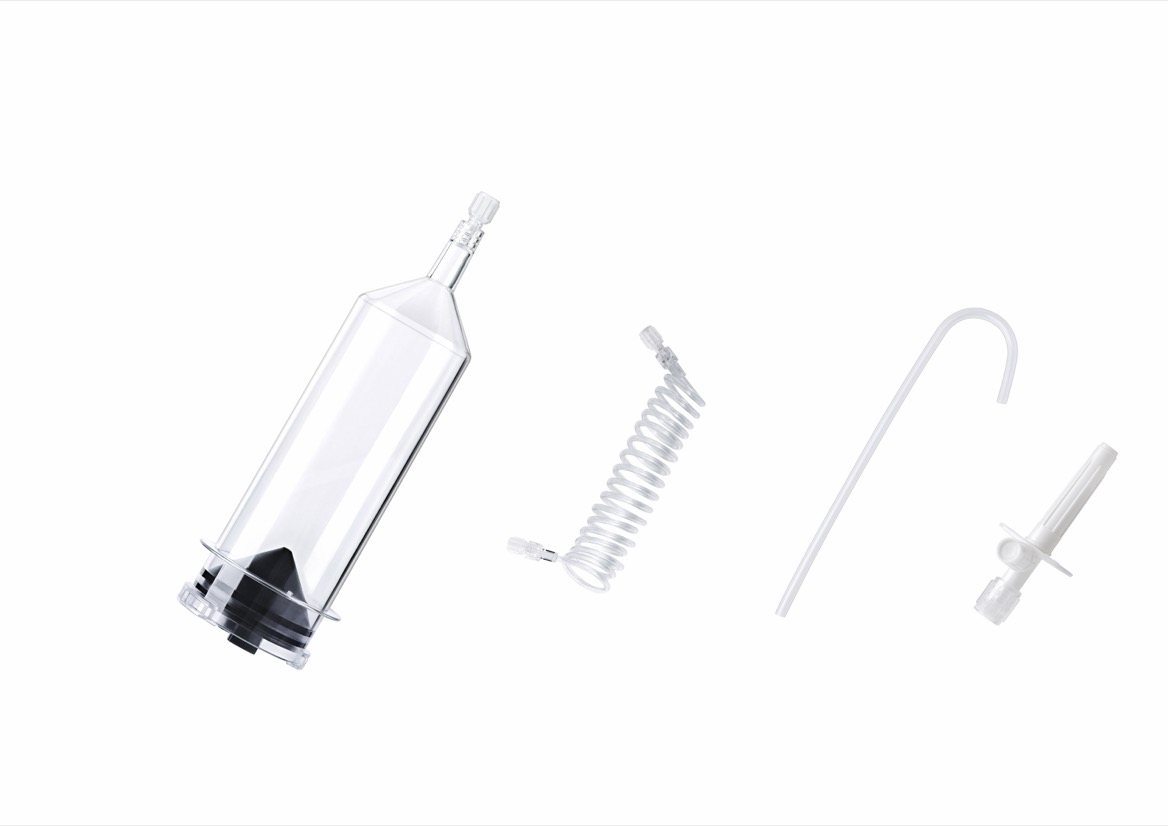
During contrast-enhanced CT, iodinated contrast changes how blood vessels and tissues attenuate X-rays. Diagnostic usefulness depends partly on delivering the contrast bolus at an appropriate rate and scanning during the intended enhancement phase.
A power injector drives a piston against the syringe plunger. The resulting pressure moves contrast through the connecting tubing and vascular access device.
The syringe must therefore perform several tasks:
- Fit and lock into the specified injector.
- Maintain an effective seal during injection.
- Support the intended operating pressure.
- Allow inspection of the fluid pathway.
- Function with the designated connecting accessories.
Compatibility means more than a syringe fitting into an injector holder. The plunger interface, mounting geometry, pressure rating, and instructions for use must all match the intended application.
The injector controls delivery; the syringe and downstream components must support that delivery within their validated limits.
Flow rate describes the volume injected per second, usually in mL/s. Iodine delivery rate describes the mass of iodine delivered per second.
The relationship is:
Iodine delivery rate (g I/s)=[Concentration (mg I/mL)×Flow rate (mL/s)]/1000
For an illustrative protocol, contrast containing 350 mg I/mL injected at 4 mL/s produces an iodine delivery rate of 1.4 g I/s.
This calculation explains why concentration and flow rate must be considered together. It is not a patient-specific recommendation.
A higher programmed flow rate does not automatically produce better imaging. Patient characteristics, examination type, vascular access, scan timing, and the contrast formulation all influence protocol selection.
Injection duration depends on contrast volume and flow rate. For example, delivering 80 mL at 4 mL/s produces a nominal injection duration of 20 seconds.
However, the contrast bolus reaching the patient is also affected by the delivery pathway. Tubing characteristics, resistance, and pressure-related expansion can influence how closely actual delivery follows the programmed profile.
This is particularly relevant when a short acquisition window makes bolus timing important.
High pressure injector syringes must tolerate the conditions specified for their intended use. But higher injection pressure is not inherently desirable.
Pressure is needed to overcome resistance. That resistance depends on factors including:
- Contrast viscosity.
- Injection flow rate.
- Tubing length and internal diameter.
- Catheter characteristics.
- Restrictions, kinks, or partially obstructed connections.
More viscous contrast generally requires greater pressure under otherwise comparable conditions. Contrast warming can reduce viscosity, but storage and warming practices must follow the contrast manufacturer's labeling and institutional procedures.
If the system reaches its configured pressure limit, the injector may reduce flow, interrupt injection, or respond in another device-specific way. Staff should understand the behavior of their particular equipment.
Increasing the pressure limit is not a substitute for investigating unexpected resistance.
A useful product evaluation connects design features to practical verification.
| Feature | Why it matters | What buyers should verify |
|---|---|---|
| Injector interface | Supports correct mounting and piston engagement | Exact supported models and configurations |
| Pressure specification | Defines the validated operating boundary | Labeled rating and applicable test conditions |
| Barrel and plunger | Support sealing and fluid displacement | Relevant performance documentation |
| Fluid-path visibility | Helps staff inspect the prepared system | Visibility under normal preparation conditions |
| Connecting interface | Links the syringe to the delivery pathway | Approved tubing and connector compatibility |
| Sterile packaging | Protects the device before use | Packaging integrity, expiry, and storage instructions |
| Traceability | Supports complaint investigation and stock control | Product identification and lot information |
From a manufacturing standpoint, consistent dimensions and controlled assembly are important. However, purchasers should evaluate documented performance rather than infer quality from appearance alone.
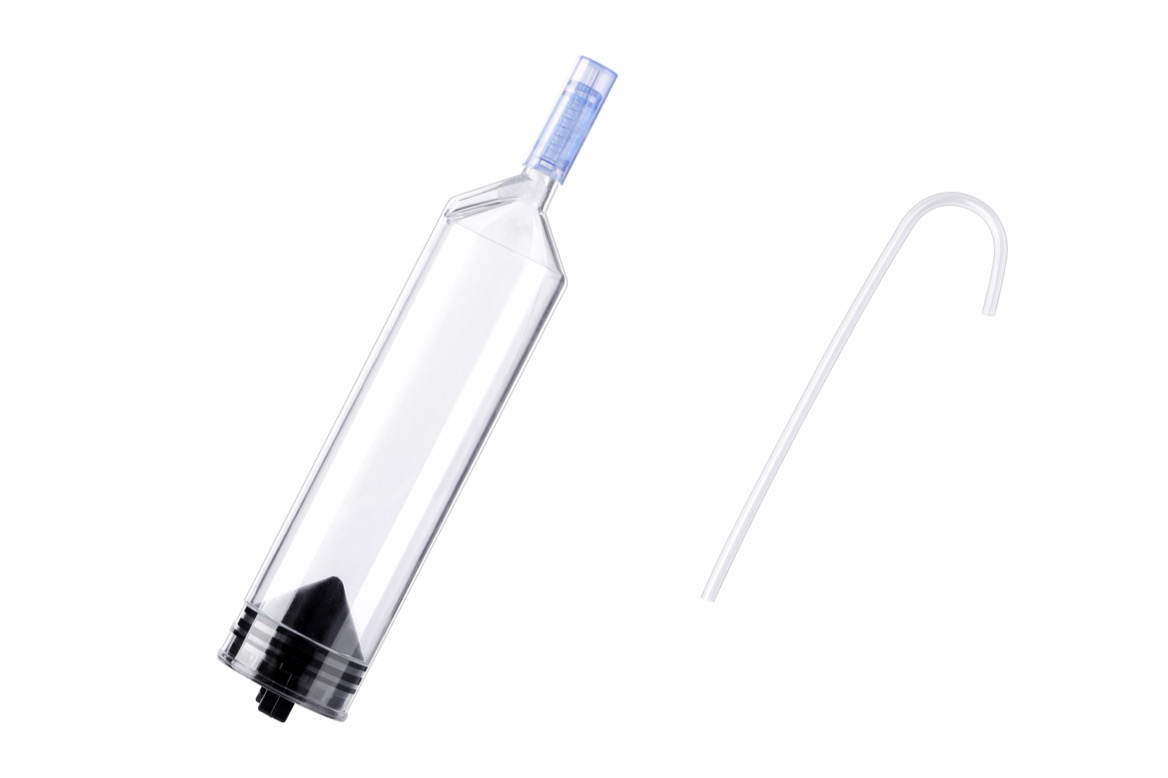
A syringe does not deliver contrast in isolation. The connecting tube, extension components, connectors, and vascular access device all influence system behavior.
The allowable operating conditions must respect every component's labeling. A high-rated syringe does not make a lower-rated accessory suitable for higher-pressure injection.
Unnecessary tubing length and restrictive components may increase resistance. Conversely, replacing a tubing set with a different design without evaluation can change delivery behavior.
The practical goal is a validated, compatible pathway—not a collection of individually impressive specifications.
Compliance describes how much a component expands under pressure. Research has highlighted that expansion of injector disposables can temporarily retain fluid and affect bolus delivery.
Residual volume also matters. Contrast remaining in the tubing is not immediately available in the patient's circulation.
These effects explain why syringe selection, tubing selection, and saline-flush design should be reviewed together rather than as unrelated purchasing decisions.
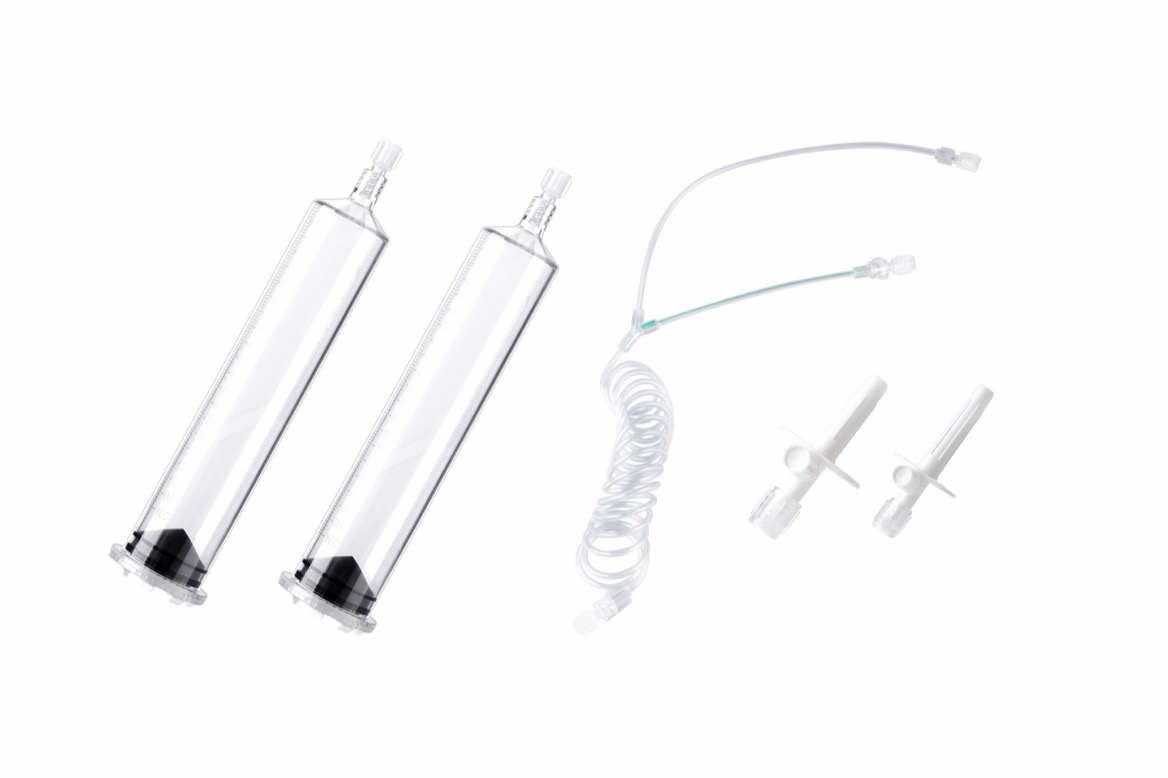
In a dual-syringe configuration, one syringe commonly contains contrast and the other saline.
A saline flush can help move contrast remaining in the delivery pathway into the circulation. Depending on the examination, it may also help shape the bolus and reduce artifacts associated with concentrated contrast in central veins.
However, there is no single flush volume suitable for every patient and setup.
The appropriate protocol depends on the examination, patient factors, tubing configuration, vascular access, and local clinical policy. A manufacturer should not present one flush setting as universally correct.
For procurement teams, the relevant question is whether the complete syringe-and-tubing configuration supports the department's validated protocols.
The following framework supports equipment preparation discussions. It does not replace clinical training, device instructions, or institutional protocols.
1. Confirm the product configuration.
Check the injector model, syringe reference, tubing set, and intended use.
2. Inspect packaging and labeling.
Verify package integrity, expiry, and traceability information.
3. Prepare the fluid pathway.
Follow the specified filling and priming procedure. Inspect for visible air and remove it according to the device instructions.
4. Check connections and mounting.
Confirm secure syringe engagement and correctly assembled fluid-path connections.
5. Verify vascular access suitability.
Trained staff should assess access patency and suitability for the prescribed flow. Central access devices must be specifically identified as suitable for power injection, with their limits respected.
6. Confirm the protocol and observe injection.
Check contrast concentration, volume, flow, pressure settings, and flush sequence. Respond promptly to pain, swelling, leakage, or equipment alarms.
Extravasation can occur even when equipment appears to function normally. Pressure monitoring alone does not establish that an injection is safely entering the vein.
Consider an illustrative scenario: a department notices repeated pressure-limit events after changing its connecting tube set.
It would be premature to blame the syringe or increase the pressure setting. A structured review should compare:
- Previous and replacement tubing dimensions.
- Connector configuration and potential restrictions.
- Contrast formulation and preparation conditions.
- Catheter characteristics and access suitability.
- Injector logs and actual flow behavior.
Where appropriate, authorized staff can evaluate delivery performance using approved non-patient testing procedures.
This example shows why troubleshooting should examine the whole pathway. A component change that seems minor commercially may still affect injection resistance or delivery consistency.
It is an illustrative evaluation scenario, not a reported MAIWEI clinical case.
"Compatible with major brands" is a starting point, not a complete purchasing specification.
Request a compatibility matrix identifying the exact injector model, syringe reference, connecting accessories, and relevant limitations.
When mixed equipment fleets are involved, map consumables to each installed device. Similar-looking syringes should not be treated as interchangeable.
Regulatory documents answer different questions.
ISO 13485 certification concerns the medical-device quality management system within its stated scope. CE marking relates to conformity with applicable European requirements. FDA 510(k) clearance reflects a substantial-equivalence determination for a particular device.
These terms should not be presented as interchangeable certifications. A 510(k) clearance is not the same as FDA approval.
Buyers should review current documents for the exact product and destination market rather than assume that company-level credentials cover every catalog item.
Purchase price is only one part of the decision. Buyers can also examine:
- Preparation steps and training requirements.
- Packaging usability and labeling clarity.
- Traceability and complaint-handling processes.
- Shelf life and inventory requirements.
- Supply continuity and change-notification arrangements.
A structured evaluation helps connect technical suitability with day-to-day operational needs.
MAIWEI INC. focuses on the research, development, and manufacturing of consumables for CT, MRI, and angiography injection applications.
According to our company profile, our portfolio includes high pressure injector syringes, connecting tubes, and associated consumables compatible with multiple mainstream injector platforms. We serve hospitals, distributors, and OEM customers across more than 60 countries and regions.
Our stated credentials include ISO 13485 certification, CE marking, and FDA 510(k) clearances. Buyers should confirm the applicable product scope, current documentation, and market-specific requirements during qualification.
For a focused product discussion, contact MAIWEI INC. with your injector manufacturer and model, required syringe capacity, tubing configuration, destination market, and estimated demand. These details allow compatibility and documentation requirements to be reviewed before sample evaluation or procurement.
It holds contrast or saline in a compatible power injection system. The injector drives the plunger to deliver fluid through the connected pathway at programmed settings, subject to equipment and accessory limits.
No. Use only syringes specified as compatible with the exact injector and intended configuration. Physical resemblance does not establish suitable mounting, plunger engagement, or pressure performance.
Not by itself. Pressure overcomes delivery resistance. Image enhancement depends on factors including iodine delivery, bolus timing, patient circulation, and acquisition parameters—not simply a higher pressure setting.
It helps move contrast remaining in the delivery pathway into circulation and can support the intended bolus profile. The appropriate volume and rate depend on the clinical protocol and system configuration.
No syringe can eliminate extravasation risk. Appropriate vascular access assessment, correct preparation, patient observation, and timely response remain essential, even when compatible equipment is used.
Request model-specific compatibility information, instructions for use, pressure specifications, sterility and shelf-life information, traceability details, and applicable regulatory documents. Requirements should match the product and destination market.
1. American College of Radiology. *ACR Manual on Contrast Media*, 2024. Guidance on contrast administration, vascular access, power injection, and extravasation. [geiselmed.dartmouth]
2. University of California, San Francisco, Department of Radiology and Biomedical Imaging. *CT and X-ray Contrast Guidelines Information*. Clinical guidance on intravenous access assessment, preparation, and injection monitoring. [radiology.ucsf]
3. *Critical but commonly neglected factors that affect contrast medium administration in CT*. 2024. Technical discussion of catheter resistance, disposable-component expansion, viscosity, and saline flushing. Full text available through PubMed Central. [pmc.ncbi.nlm.nih]
4. *Intravenous contrast medium extravasation: systematic review and updated ESUR Contrast Media Safety Committee Guidelines*. 2022. Evidence review addressing extravasation risk, prevention, and management. Full text available through PubMed Central. [pmc.ncbi.nlm.nih]
5. U.S. Food and Drug Administration. *Premarket Notification 510(k)*. Explanation of substantial equivalence and clearance for commercial distribution. [fda]