


close
Choose Your Site
Global
Social Media
Views: 228 Author: Maiwei Biotech Publish Time: 2026-11-02 Origin: Site


Content Menu
● Why Source MRI Injector Syringes from China?
>> A substantial medical-device export base
>> A concentrated Shenzhen supplier base
● How These Manufacturers Were Selected
● Manufacturer Comparison: Capacity, MOQ, and Compliance Evidence
● 1. MAIWEI INC. / Shenzhen Maiwei Biotech
>> A candidate for coordinated manufacturing and responsive project support
>> Broad contrast-delivery specialization and international reach
● 3. Shenzhen Boon Medical Supply
>> Particularly strong product-specific documentary evidence
● 4. Shenzhen LnkMed Medical Technology
>> A product-focused option for imaging-system procurement
● 5. Shenzhen Seacrown Electromechanical
>> Injector-system expertise with an identifiable OptiStar consumable
>> Published compatibility instructions and configurable supply
● Technical Buying Guide: What a Guerbet-Compatible MRI Syringe Must Demonstrate
>> Match the exact injector—not just the brand name
>> Evaluate the finished fluid path, not a resin label
>> Distinguish quality systems, market access, and environmental rules
● An Overlooked Procurement Trap: The "Same Syringe" May Not Be the Same Kit
● Factory Verification, Sampling, and Logistics
>> Verify the legal and manufacturing chain
>> Use a staged sample process
>> Define the delivery clock correctly
● Conclusion: Choose a Documented Configuration, Not Just a Supplier Name
● FAQs
>> 1. How can I check whether an ISO 13485 certificate is expired, suspended, or outside scope?
>> 2. Does a supplier's FDA registration prove its OptiStar syringe is cleared?
>> 3. Can a 350 psi compatible syringe automatically replace a 300 psi kit?
>> 4. Can we change tubing length, valves, or packaging without affecting the regulatory position?
Choosing a Guerbet MRI syringe supplier requires more than comparing prices for a 60 mL barrel. Procurement teams need to establish which injector models the product supports, which legal manufacturer controls production, and whether the complete syringe-and-tubing configuration is covered by appropriate documentation.
China offers several manufacturers with publicly documented products for Liebel-Flarsheim OptiStar MRI injection systems. However, their supporting evidence differs: some provide regulator-reviewed compatibility tables, while others publish product specifications that require further verification before purchasing.
This guide evaluates six manufacturers and manufacturing networks against practical purchasing criteria: factory credentials, development capability, quality controls, delivery transparency, and support for distributor or private-label projects.
The central purchasing principle is traceability: the quotation, sample, technical file, regulatory documentation, and delivered product should all identify the same approved configuration.
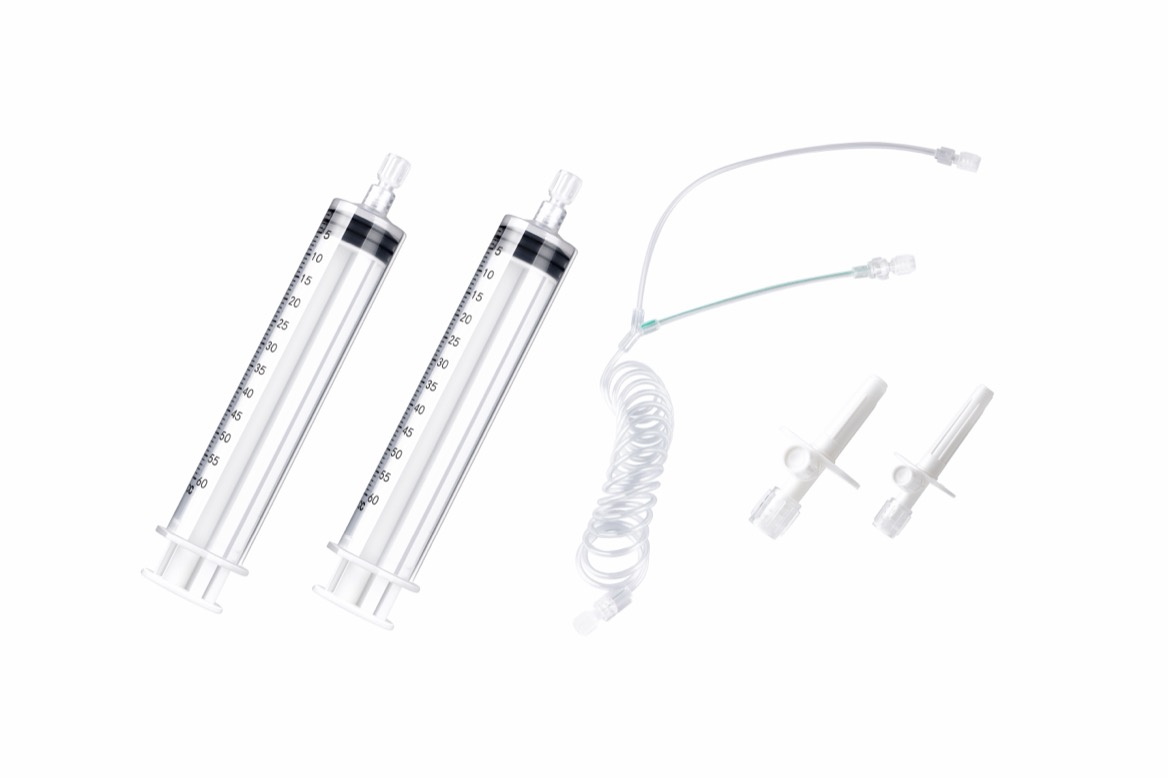
According to the China Chamber of Commerce for Import & Export of Medicines & Health Products, China exported US$50.469 billion in medical devices in 2025, an increase of 3.54% year over year. Single-use consumables accounted for US$10.911 billion, growing by 3.77%. These figures describe broad industry categories—not the market size of Guerbet-compatible MRI syringes.
The association subsequently reported medical-device exports of US$12.585 billion in the first quarter of 2026, up 8.92% year over year. These figures indicate continuing export activity, but they should not be interpreted as evidence of any individual factory's capacity or product quality.
For this particular sourcing exercise, Shenzhen stands out. MAIWEI's Chinese manufacturing entity, Antmed, Boon, LnkMed, Seacrown, and Union Medical all have Shenzhen operations or addresses identified in their public materials. That concentration gives buyers a practical way to organize multi-supplier qualification visits within one region.
The useful cluster advantage is not simply geographic proximity. Buyers can compare companies specializing in complete injection systems, compatible disposables, and related fluid-path components without treating them as identical businesses.
This is an editorial procurement shortlist, not an independently audited ranking or a market-share league table. MAIWEI is presented first because this guide is prepared for its website; the order should not be interpreted as proof of superior clinical performance.
The following proposed evaluation framework helps purchasing teams conduct their own qualification.
| Evaluation area | Suggested weight | Evidence to request |
|---|---|---|
| Regulatory and quality-system documentation | 30% | Current certificates, product coverage, legal manufacturer, relevant market authorization |
| Injector compatibility and performance | 25% | Model-specific compatibility evidence, pressure specifications, connection and leakage testing |
| Manufacturing and quality controls | 20% | Process flow, cleanroom controls, sterilization arrangements, lot-release records |
| OEM/ODM development capability | 15% | Change-control procedure, customization boundaries, validation responsibilities |
| Delivery and service reliability | 10% | Released-stock availability, production schedule, complaint handling, communication ownership |
No numerical scores are assigned to individual companies because comparable audit reports, order histories, and verified production records are not publicly available.
Published factory information is treated as supplier-reported unless a regulator or another primary document independently supports it.
The table deliberately separates disclosed facts from information that requires an RFQ. An injector production figure, factory floor area, or carton quantity should not be presented as MRI syringe production capacity.
| Manufacturer or network | Established | Published MRI syringe capacity | Product-specific MOQ | Public documentation and procurement focus |
|---|---|---|---|---|
| MAIWEI INC. / Shenzhen Maiwei Biotech | Chinese entity: 2016; U.S. company: 2021 | Not established in reviewed sources | Request a written quotation | K253048 includes 60 mL and 60/60 mL OptiStar configurations; relevant for coordinated China manufacturing and North American support. |
| Antmed | 2000 | Not established in reviewed sources | Request a written quotation | REF 200301 identifies OptiStar Elite/LE compatibility; broad international contrast-delivery portfolio. |
| Shenzhen Boon Medical Supply | 1990, supplier-reported | Not established in reviewed sources | Request a written quotation | K211564 documents model 200103 for OptiStar LE/Elite; selected LF/Guerbet-branded devices also appear in public device records. |
| Shenzhen LnkMed Medical Technology | 2018 | Not established in reviewed sources | Request a written quotation | Publishes a dual-60 mL OptiStar LE/Elite kit and states ISO 13485, CE, and FDA credentials; verify exact documents. |
| Shenzhen Seacrown Electromechanical | 2002 | Not established in reviewed sources | Request a written quotation | C03-017-10 is listed as a dual-60 mL LF OptiStar MR kit; confirm destination-market documentation. |
| Union Medical Shenzhen | 2015 | Not established in reviewed sources | Request a written quotation | Published IFU includes SLF301 for LF OptiStar MR; company reports ISO/CE credentials and customizable labels/configurations. |
For meaningful capacity comparison, ask every supplier the same question: "How many finished, sterilized, released sets of this exact configuration can you allocate monthly under our forecast?"
MAIWEI INC. states that it was established in 2021 to support demand for contrast-media delivery solutions in the United States. Its company history identifies the establishment of Shenzhen Maiwei Biotech in 2016. These dates refer to different entities and should not be merged into a single corporate founding date.
The strongest publicly verifiable product evidence is FDA clearance K253048, issued to Shenzhen Maiwei Biotech Co., Ltd. on April 16, 2026. Its compatibility table includes:
- B01305: 60/60 mL, 350 psi, for OPTISTAR.
- B01301: 60 mL, 350 psi, for OPTISTAR MR.
The submission also describes high-pressure syringes, connecting tubes, spikes, transfer tubes, and quick-fill tubes. It identifies EO sterilization, biological evaluation, connector testing, and packaging validation within the submitted device documentation.
The U.S. company's stated commercial focus is North America. MAIWEI also reports exports to more than 60 countries and regions in the company information supplied for this guide; buyers should request destination-specific references rather than treating that reach as independently audited.
For smaller and midsize brands, MAIWEI is worth evaluating for coordinated sourcing of syringes and associated fluid-path components. Its public materials emphasize responsive customer support and experienced contrast-delivery personnel.
A practical OEM discussion should cover:
- Private-label packaging and labeling requirements.
- Standard versus customized kit configurations.
- Distributor documentation support.
- Engineering review of proposed component changes.
- Clear responsibility for regulatory assessment and validation.
These are negotiation topics, not evidence that every requested change is already validated.
Procurement assessment: MAIWEI offers a documented starting point for OptiStar-compatible sourcing. Its value-for-money, flexibility, and communication efficiency should be tested through a structured sample project and itemized quotation—not assumed from promotional language.
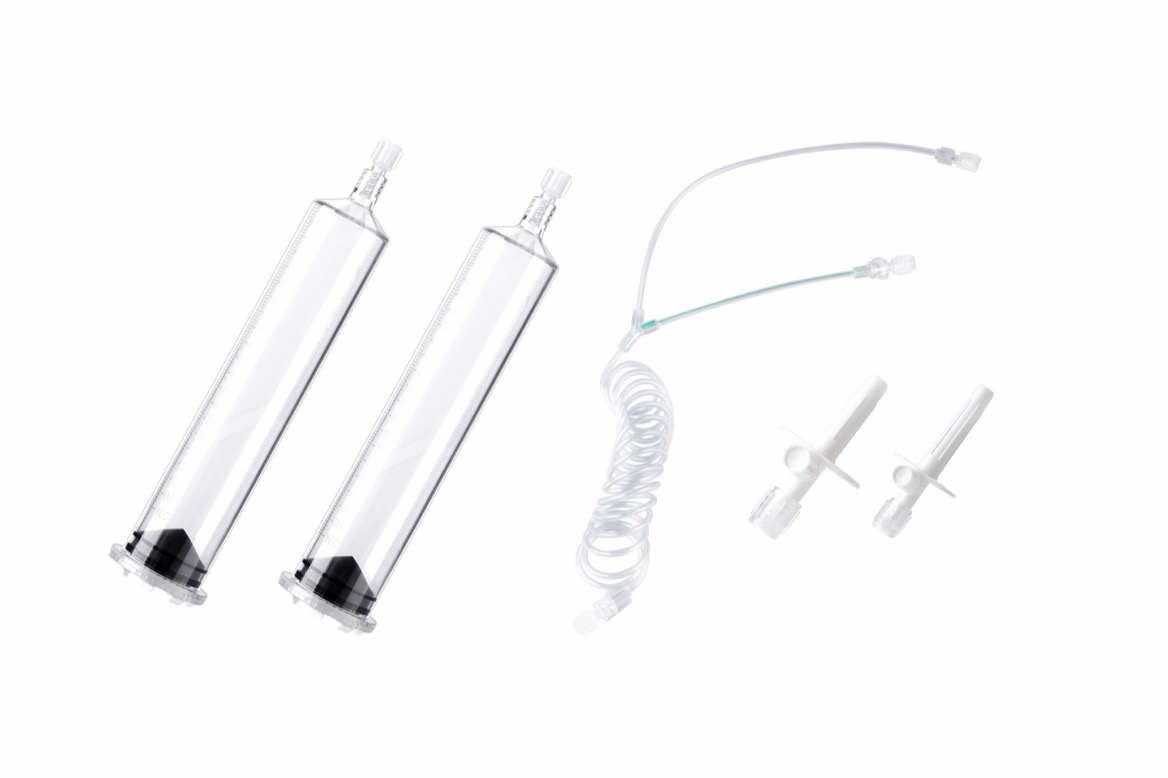
Founded in 2000, Antmed develops contrast-delivery systems and related medical disposables. Its current website states that its injectors, syringes, and disposable pressure transducers are exported to more than 130 countries.
For the target application, Antmed's REF 200301 page identifies compatibility with Guerbet/Liebel-Flarsheim MRI OptiStar Elite and OptiStar LE systems and lists two 60 mL syringes.
The company describes an integrated operating model covering development, tooling, sterilization, and after-sales service. Its stated geographic reach spans the Americas, Europe, Asia, Oceania, and Africa.
Antmed is relevant to distributors seeking a broader contrast-delivery portfolio rather than a single compatible syringe line.
For OEM/ODM projects, establish whether the quotation covers only an existing validated configuration or includes additional packaging, component, tooling, or development work. The reviewed public product information does not establish universal customization terms, MOQ, or reserved production capacity.
Procurement assessment: a logical candidate for buyers prioritizing portfolio breadth and international distribution experience, subject to product-specific documentation and commercial qualification.
Boon's supplier materials state a founding year of 1990. More importantly for this category, FDA document K211564 identifies model 200103 as a 60/60 mL dual-shot syringe configuration compatible with OptiStar LE/Elite, with a listed pressure rating of 300 psi.
Public device records provide additional context. AccessGUDID identifies Shenzhen Boon Medical Supply as the company associated with an LF-branded 60 mL MR syringe with spike, catalog number 801801B, described as fitting OptiStar Elite and OptiStar LE. Another public record identifies a Guerbet-branded dual-syringe configuration associated with Boon.
These records support specific manufacturer–product relationships. They do not establish that every Boon product is an original Guerbet consumable or that every reseller is authorized.
The reviewed primary records establish U.S.-market product documentation. They do not provide a reliable breakdown of Boon's principal sales markets.
Boon's supplier listing states that OEM service is available. Buyers should ask which exact configurations can be supplied under private label and whether the proposed labeling and distribution arrangement are covered by the appropriate documentation.
Procurement assessment: particularly relevant when the purchasing team values identifiable product records and a clear distinction between branded supply and independent compatible supply.
LnkMed states that it was founded in 2018 and specializes in contrast-media injection systems and related products. Its published company material reports exports to more than 20 countries, without providing a detailed principal-market breakdown.
Its OptiStar-compatible product page lists a kit containing:
- Two 60 mL MRI syringes.
- One 250 cm Y-connecting tube.
- One large spike and one small spike.
The page identifies the application as Liebel-Flarsheim OptiStar LE/Elite and publishes a three-year shelf life.
LnkMed markets an OEM OptiStar syringe product and states quality-system and regulatory credentials on its website. Procurement teams should request current certificates and the applicable clearance or authorization documents rather than relying on the wording "CE ISO FDA" in a product title.
Ask separately about finished syringe-set capacity. A published injector manufacturing rate is not evidence of disposable-kit output.
Procurement assessment: useful for distributors considering both injection equipment and compatible consumables, provided the exact product configuration and market access are verified.
Seacrown states that it was founded in 2002 and develops CT, MRI, and DSA contrast-media injectors. It also identifies the establishment of an overseas company in 2006.
Its C03-017-10 consumable listing describes two 60 mL syringes, a 250 cm Y-connector tube with one check valve, and separate saline and contrast spikes. The listing specifies LF OptiStar MR application and a 350 psi pressure limit.
Seacrown has an international business presence, but the reviewed materials do not establish its principal sales territories or detailed OptiStar OEM/ODM terms.
Buyers should request confirmation of:
- The precise injector versions supported.
- Current product-specific certificates.
- The legal manufacturer named on the label.
- Private-label availability and change-control responsibilities.
Procurement assessment: worth considering where injector-system knowledge matters, but a product listing should remain the beginning—not the conclusion—of qualification.
Union Medical, also known as UNIONMED, states that it was founded in 2015. Its website reports a 4,500 m² factory site, a 1,500 m² cleanroom workshop, and exports to more than 80 countries and regions. These are company-reported figures, not independently audited capacity measurements.
Its published instructions for use identify SLF301 as a 60/60 mL configuration for LF OptiStar MR, with a 250 cm connector tube and separate filling spikes. The listed pressure limit is 2.4 MPa, approximately 350 psi.
Union Medical does not disclose its largest destination markets in the reviewed materials. Its website explicitly identifies labels and product configurations as examples of available customization.
The company also publishes an indicative production lead time of approximately three days to two weeks. Buyers should confirm whether that estimate includes sterilization, quality release, labeling approval, and export preparation for their particular order.
Procurement assessment: a useful candidate for distributors seeking documented compatibility and configurable supply, with current regulatory scope and committed delivery dates still requiring confirmation.
"Guerbet compatible" is too broad for a purchase specification.
Request the injector model, syringe reference, kit contents, tubing length, valve arrangement, pressure rating, and applicable IFU. The reviewed documents demonstrate why this matters: different manufacturers publish different pressure ratings and kit configurations for OptiStar-related products.
Do not increase an injector's operating pressure because a replacement syringe carries a higher component rating. The original injector documentation and the applicable consumable instructions remain essential constraints. Guerbet's own brochure distinguishes injector settings from the ratings of individual syringes and tubing products.
There is no single material name that proves suitability.
MAIWEI's FDA summary, for example, identifies PC or PP syringe barrels and tubing materials that differ from those used in its predicate device. The summary explains that patient-contact materials were evaluated through biological testing. This illustrates why "medical-grade plastic" alone is insufficient evidence.
Request a controlled bill of materials covering the barrel, plunger, lubricant, tubing, adhesive, connectors, and valves. Require an assessment of the finished sterilized configuration, not merely a raw-material supplier's certificate. FDA guidance places biological evaluation within a risk-management framework for devices that directly or indirectly contact the body.
ISO 13485 certification, CE documentation, and FDA clearance answer different questions. FDA's regulatory overview treats establishment registration and 510(k) requirements separately; the existence of a registered establishment does not replace product-specific clearance evidence where required.
RoHS addresses hazardous substances in electrical and electronic equipment. It should not be used as the primary quality credential for a passive disposable syringe kit. Procurement teams should determine actual applicability rather than treating RoHS as a universal medical-consumable certification.
A revealing detail appears in the public evidence: MAIWEI's OptiStar-related syringe configurations are listed at 350 psi, while Boon's K211564 lists its OptiStar LE/Elite dual-shot configuration at 300 psi. Guerbet's brochure also lists different pressure ratings for different tubing products.
The practical lesson is easy to miss: similar-looking barrels do not establish identical fluid-path performance.
A supplier may quote an apparently equivalent kit while changing the tubing, valve, connector, lubricant, or packaging. Those differences can matter even when the syringe volume and product photograph remain unchanged.
To prevent an uncontrolled substitution:
1. Approve the full kit bill of materials.
2. Record tubing dimensions and valve placement.
3. Identify the validated pressure limits of the supplied configuration.
4. Retain an approved reference sample.
5. Require written notification and assessment of material, tooling, component, sterilization, and packaging changes.
These controls are consistent with the design and production change-management responsibilities described in the FDA clearance documentation.
Before paying for a production order, map the relationship between the seller, legal manufacturer, production site, sterilization provider, and importer.
For MAIWEI, this means distinguishing the U.S. commercial company from Shenzhen Maiwei Biotech, the applicant named in K253048. Similar checks should be applied to every shortlisted supplier.
A practical qualification sequence is:
1. Document review: confirm model compatibility, labeling, certificates, and intended use.
2. Engineering evaluation: check installation, locking geometry, connections, and priming using an appropriate nonclinical test setup.
3. Performance review: assess applicable leakage, pressure, connector, and valve evidence.
4. Production-representative samples: evaluate the final sterilized and packaged configuration.
5. Pilot order: confirm lot consistency, delivered documentation, and service response.
Agree acceptance criteria before testing. Where a test is destructive or requires specialist equipment, use a qualified laboratory rather than an informal demonstration.
Ask whether the quoted lead time starts after payment, artwork approval, material availability, or final technical approval.
Separate manufacturing completion from sterilization completion, quality release, and dispatch readiness. EO sterilization, residual evaluation, and sterile-barrier validation are distinct technical elements in the reviewed device documentation.
For logistics, agree minimum remaining shelf life on arrival, storage conditions, carton protection, shipment responsibilities, and the procedure for handling damaged sterile packaging. Use the selected product's validated labeling—not assumptions based on another manufacturer's shelf-life claim.
A defensible purchasing decision connects the injector model, complete consumable configuration, legal manufacturer, supporting documentation, and delivered lot.
For buyers considering MAIWEI, the productive next step is a configuration-specific RFQ. Provide your OptiStar model, destination market, expected annual volume, tubing and valve requirements, and private-label needs.
Ask MAIWEI to return a model-matched quotation, applicable regulatory documents, sample plan, customization assessment, and written delivery proposal. Compare the same information across the shortlist before committing to a long-term supply agreement.
Start with the certification body named on the certificate. Ask it to confirm the certificate number, legal entity, manufacturing address, scope, current status, and expiration date. An apparently valid date does not rule out suspension or withdrawal.
Accredited-certificate databases can provide an additional cross-check, but confirmation from the issuer remains important. Published accreditation guidance specifically advises purchasers to approach the certification body first.
No. Establishment registration and product clearance are separate regulatory matters. Request the relevant 510(k) number and compare the device, model, intended use, and compatibility information with the actual quotation.
For example, K253048 names Shenzhen Maiwei Biotech and includes specific OptiStar-related models. That is more useful than a generic statement that a company is "FDA registered."
Not on pressure rating alone. Compatibility also depends on the injector interface, complete fluid path, operating conditions, labeling, and intended configuration.
The reviewed sources contain both 300 psi and 350 psi OptiStar-related listings. Those differences require document-based evaluation; they do not establish automatic interchangeability.
Do not assume so. Require a documented change assessment before approving the modification.
A supplier should determine the effect on performance, biological safety, sterilization, sterile-barrier integrity, labeling, and any additional regulatory requirements. FDA's K253048 letter expressly discusses the need to review and approve design and production changes and points to guidance on changes that may require a new submission.
No. Public records establish specific product relationships, not blanket authorization for all products or distribution channels.
Request the exact catalog reference, manufacturer labeling, supply-chain records, and any claimed distribution authorization. Keep independently branded compatible products separate from original-brand products in quotations and tender documents.
- China Chamber of Commerce for Import & Export of Medicines & Health Products: 2025 medical-device trade analysis, including total exports and single-use consumables. [cccmhpie.org]
- The same association: first-quarter 2026 medical-device export figures. [cccmhpie.org]
- U.S. FDA: Shenzhen Maiwei Biotech clearance K253048 and technical summary. [accessdata.fda]
- U.S. FDA: Shenzhen Boon Medical Supply clearance K211564 and compatibility table. [accessdata.fda]
- U.S. National Library of Medicine AccessGUDID: selected LF- and Guerbet-branded device records associated with Boon. [accessgudid.nlm.nih]
- Guerbet: OptiStar Elite brochure and consumable specifications. [guerbet]
- U.S. FDA: biological evaluation guidance and device-regulation overview. [fda]
- European Commission: RoHS scope and technical guidance. [environment.ec.europa]