


close
Choose Your Site
Global
Social Media
Views: 231 Author: Maiwei Biotech Publish Time: 2026-11-20 Origin: Site


Content Menu
● How the CT Power Injector Syringe and Tubing Work Together
>> Syringe fit is not the same as documented compatibility
>> Tubing length, internal diameter, and fittings change resistance
● How Pressure Limits Affect Achieved Flow and Bolus Timing
>> What an injector pressure trace can—and cannot—tell you
● Tubing Fill Volume and the Saline Chaser
● What to Check Before Switching CT Injector Consumables
>> Match regulatory documents to the part number, not just the supplier
● Request a Model-Specific Compatibility Review
>> Can I replace a CT injector syringe with another one of the same capacity?
>> Does longer CT contrast tubing always reduce flow?
>> Does a higher tubing pressure rating allow faster contrast injection?
>> Should we change the saline phase when switching tubing?
>> Can an injector pressure alarm confirm extravasation?
>> Can a tubing set used for CT also be used for MRI or angiography?
In CT contrast injection, the programmed flow rate tells you what the power injector is asked to deliver. It does not tell you what the assembled fluid path can sustain. The CT power injector syringe, high-pressure connecting tubing, fittings, and vascular access device all influence the pressure required to move contrast. A tubing substitution that looks minor on a purchasing form can change the pressure recorded during an injection, reduce the achieved flow, or affect when the contrast bolus reaches the patient.
From a consumables manufacturer's perspective, the most useful question is not "Does this syringe fit?" It is "Can we document that this exact syringe and tubing configuration is suitable for the intended injector and workflow?" This guide explains what changes delivery, what an injector pressure trace can and cannot tell you, and what imaging departments, distributors, and OEM teams should verify before approving a replacement set.
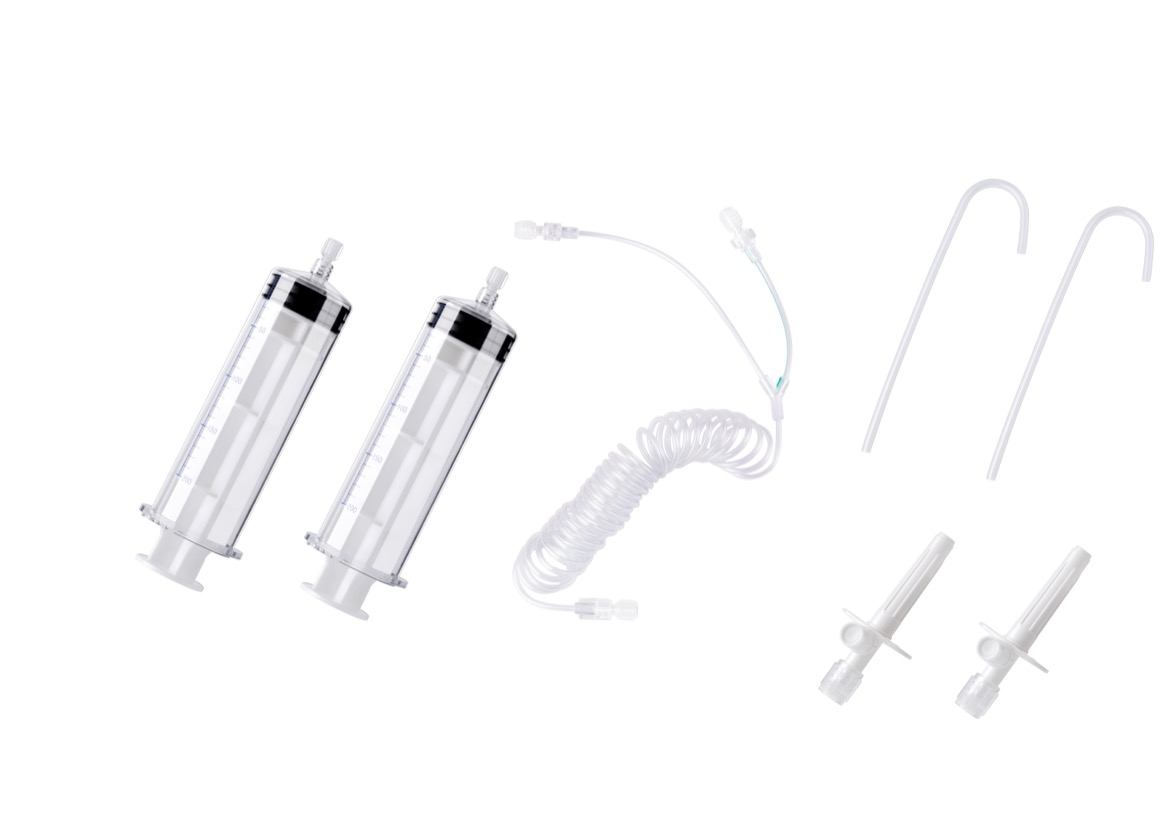
A contrast injection system has a continuous fluid path: from the syringe outlet through the connecting tubing and fittings to the vascular access device. The injector moves the fluid, but the full assembly determines how much resistance the injector encounters. That is why a pressure reading can change even when the programmed flow rate and contrast volume remain the same.
A compatible syringe must do more than slide into the injector head. Its barrel and plunger must interface with the injector as intended, and its outlet must connect to the specified tubing assembly. Syringe capacity alone does not establish compatibility. Two syringes with the same nominal volume may be intended for different injector models or supplied with different accessories. For a replacement, start with the exact injector model and the consumable part number, then check the applicable instructions for use (IFU).
The syringe and tubing can also expand slightly under pressure. This property, called system compliance, means the fluid path can temporarily accommodate a small volume as pressure builds. The extent depends on the materials, geometry, temperature, and pressure. The practical distinction is that movement at the syringe plunger does not necessarily translate into identical fluid movement at the catheter tip at every instant.
Longer tubing generally creates more resistance when its internal diameter and other conditions stay the same. A narrower internal bore also increases resistance. If an injector is already operating close to its pressure limit, an added extension or a change in tubing bore may leave less room to maintain the programmed flow. More viscous contrast can make that difference easier to observe.
The opposite shortcut—choosing the shortest line available—can create a different problem. The line still needs enough reach for the intended setup and table travel without pulling on the IV connection. Evaluate usable reach, internal bore, and documented compatibility together instead of treating length as an isolated specification.
| Configuration detail | Why it matters | What to verify |
|---|---|---|
| Syringe and injector interface | Matching capacity does not establish model compatibility. | Exact injector model, syringe code, and labeled configuration |
| Tubing length and internal bore | Both affect resistance and achievable flow. | Specified dimensions and sufficient reach through intended table movement |
| Connectors and extensions | An added component changes the assembled fluid path. | Connector type, documented suitability, and applicable use limits |
| Vascular access device | Catheter design and rated limits constrain power injection. | Exact device or lumen, power-injection status, and labeled limits |
| Tubing fill volume | The line can hold contrast that has not yet reached the patient. | Documented fill volume and fit with the approved priming and saline workflow |
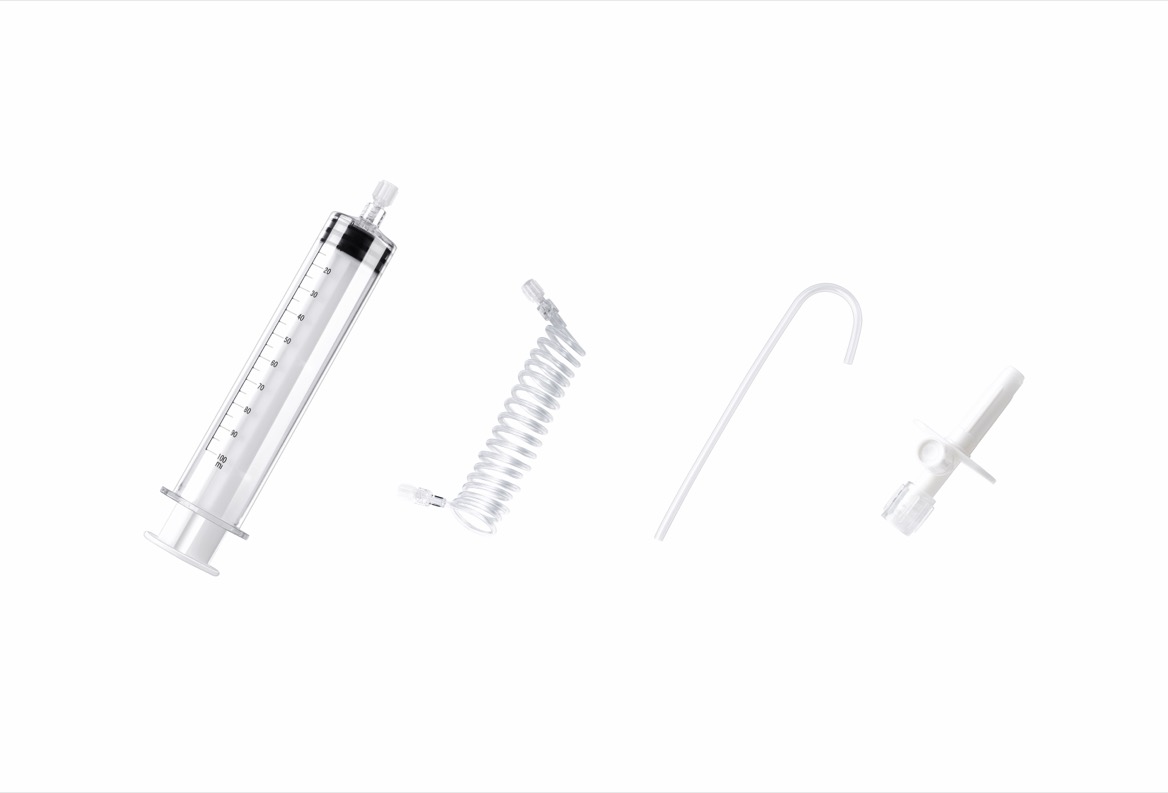
Keep three values separate when comparing injection setups: the programmed flow rate, the configured pressure limit, and the flow the system actually achieves. If resistance rises enough to reach the limit, the injector may reduce flow or interrupt delivery, depending on its design and settings. A tubing set's pressure rating does not mean that the complete assembly can safely operate at that pressure, or that it will achieve every requested flow rate. The labeled limits for the injector, consumables, and vascular access device all matter.
This distinction is especially important in CT angiography (CTA), where the timing and shape of the contrast bolus—the concentrated pulse of contrast entering circulation—matter to arterial enhancement. For example, a bench setup programmed to deliver 60 mL at 4 mL/s would take 15 seconds at a constant flow. If the actual flow averaged 3 mL/s and all 60 mL were delivered, it would take 20 seconds. The example illustrates how the same volume can be delivered over a different time window; it is not a clinical protocol.
A pressure trace can help identify when resistance increased. It cannot, on its own, tell you where the resistance arose. A tubing change, a restricted connector, a kink, or the properties of the vascular access device can all affect what the injector records. Compare equivalent setups before attributing a change to one component. Likewise, a normal-looking trace does not rule out contrast extravasation, which is leakage into tissue around the access site. Patient and access-site assessment must follow the department's clinical procedures.
When the contrast phase ends, some contrast can still be in the tubing. A saline chaser is a saline phase that follows contrast and helps move the remaining contrast through the line and peripheral veins. The transition is not a clean boundary between two liquids: mixing can leave residual contrast behind even after saline has passed through the set. Tubing fill volume is therefore useful for comparing sets, but it does not tell you exactly how much contrast a particular saline phase will recover.
In one published bench evaluation, an average of 1.4 mL of contrast remained in the tubing after a 30 mL saline flush, with results ranging from 0.3 to 3.8 mL under the conditions tested. These figures are not a recommended flush volume or a prediction for another set. Their value is in showing why a change in tubing geometry deserves review even when the replacement fits the same injector and the programmed volumes have not changed.
Consider a two-room imaging department evaluating a replacement kit. The syringe capacity and connector type match the current set, but the proposed tubing is longer. In the first room, the added reach may improve routing. In the second, a bench comparison may show that a setup already close to its pressure limit has less margin with the same replacement. The scenario is illustrative, but it highlights a real purchasing issue: one compatibility claim does not answer every question about installation and delivery.
1. Record the current configuration. List the injector model, syringe and tubing codes, tubing length, connectors, and any approved extensions. An accurate baseline makes it easier to identify what the proposed kit would change.
2. Review the proposed set's documentation. Match the exact part number to its intended use, compatible injector models, pressure limitations, and supplied accessories. A general statement such as "compatible with major injectors" is not enough to approve a particular model.
3. Compare performance away from patient care. If the department or OEM requires bench evaluation, hold the fluid, temperature, target flow, and test fixture constant when comparing sets. Where the equipment supports it, record achieved flow, pressure behavior, and interruptions rather than relying on a completed cycle alone.
4. Check the room workflow. Confirm that staff can identify the correct set, follow the labeled setup procedure, and route the line without tension during intended table travel. Include the approved item code in purchasing and training records so the evaluated set is the one actually stocked.
Ask for records that identify the exact device or kit being quoted. An ISO 13485 certificate, CE marking documentation, and an FDA 510(k) clearance record address different questions. Do not treat a company-level quality credential as proof that every SKU is cleared, covered by CE documentation, or compatible with every injector. In the United States, the FDA identifies certain changes to stated accessory compatibility as a reason to assess whether a new 510(k) is required.
For a hospital replacement, distributor quote, or OEM project, send MAIWEI INC. your injector make and model, current consumable part numbers, required tubing length, connector requirements, and destination market. Ask for a model-specific compatibility statement, the proposed kit's specifications and instructions for use, and the regulatory documentation applicable to the exact SKU. That gives your team a concrete basis for comparing offers before approving a substitution.
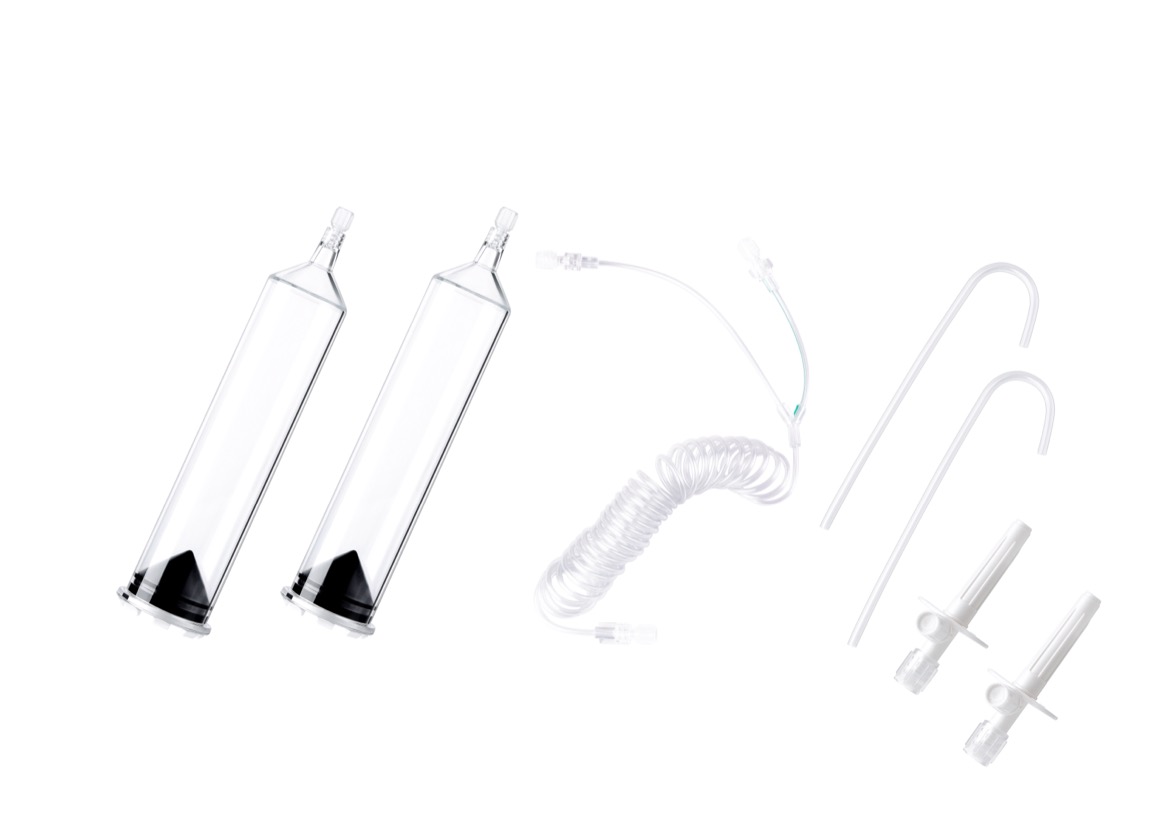
Not on capacity alone. Verify the exact injector model, syringe part number, intended configuration, and applicable instructions. Also check whether the replacement is intended for use with the tubing and accessories in the proposed kit.
No. A longer line generally requires more pressure to sustain the same flow when other variables are held constant. Achieved flow may stay unchanged if the injector has sufficient pressure margin. A difference becomes more likely when the configuration approaches its pressure limit.
Not by itself. The tubing rating is not a flow specification or permission to exceed another component's limits. Achievable flow still depends on resistance across the assembled path, and permissible use depends on the applicable device labeling and clinical protocol.
Do not change it simply because a new line is longer or has a different fill volume. Have the responsible clinical team review the approved protocol against the new configuration. Published bench findings show that residual contrast depends on more than nominal tubing volume.
No. A pressure alarm indicates that the injector detected a pressure condition; it does not establish the cause. Conversely, the absence of an alarm does not rule out extravasation. Follow the department's patient-assessment and escalation procedures if it is suspected.
Do not assume so because the connectors fit. Check the exact set's labeled intended use, injector compatibility, pressure limitations, and any requirements specific to the imaging environment before substituting it.
1. American College of Radiology (ACR). [ACR Manual on Contrast Media]. See the "Injection of Contrast Media" and "Extravasation of Contrast Media" chapters for clinical guidance. [acr]
2. [Critical but Commonly Neglected Factors That Affect Contrast Medium Administration in CT]. 2024. Discusses injection pressure, tubing and catheter characteristics, and residual contrast after a saline flush. [pmc.ncbi.nlm.nih]
3. Roditi G, Khan N, van der Molen AJ, et al. [Intravenous Contrast Medium Extravasation: Systematic Review and Updated ESUR Contrast Media Safety Committee Guidelines]. *European Radiology*. 2022. Reviews extravasation risk factors, pressure monitoring, prevention, and management. [pmc.ncbi.nlm.nih]
4. UCSF Radiology. [Vascular Access and Use of Central Lines and Ports in Adults]. Covers vascular access selection and considerations for power injection through central lines and ports. [radiology.ucsf]
5. Radiopaedia. [Saline Flush During Contrast Medium Administration]. Explains the role of a saline chaser following contrast injection. [radiopaedia]
6. Diagnostic Imaging. [Current Concepts in Preventing and Managing Contrast Media Extravasation]. 2024. Provides a clinical overview of extravasation and its prevention and management. [diagnosticimaging]
7. U.S. Food and Drug Administration (FDA). [Guidance on the Content of Premarket Notification 510(k) Submissions for Piston Syringes]. Describes the information FDA recommends including in piston syringe submissions. [fda]
8. U.S. Food and Drug Administration (FDA). [Is a New 510(k) Required for a Modification to the Device?]. Explains when changes to a marketed device may require a new 510(k). [fda]
9. U.S. Food and Drug Administration (FDA). [510(k) Premarket Notification K252652: Disposable Syringes with Accessories for Power Injectors]. A device-specific public record, not evidence of clearance for products outside that record. [accessdata.fda]