


close
Choose Your Site
Global
Social Media
Views: 219 Author: Maiwei Biotech Publish Time: 2026-10-23 Origin: Site


Content Menu
● What Is Included in a CT Contrast Injector Syringe Kit?
● High-Pressure Syringes: More Than a Fluid Reservoir
>> Injector Fit and Drive Engagement
>> Capacity and Pressure Specifications
● CT Injector Tubing: Connecting Performance and Workflow
>> High-Pressure Tubing Is Not Ordinary Extension Tubing
>> Tubing Length, Internal Volume, and Resistance
>> T-Connectors and Check Valves
● Filling Components: How Fluid Enters the Syringe
>> Transfer Tubes and Other Filling Accessories
● Single-Syringe and Dual-Syringe Kits: What Changes?
● Three Often-Overlooked Purchasing Checks
>> 1. Evaluate the Complete Fluid Pathway
>> 2. Include Priming Volume in Workflow Evaluation
>> 3. Compare Cost per Usable Procedure
● A Practical Pre-Use Review for Trained Staff
● Documentation That Supports Supplier Approval
>> Product-Specific Market Documentation
>> Traceability and Change Control
>> What is a CT contrast injector syringe kit?
>> Are CT injector syringe kits universally compatible?
>> Can ordinary IV extension tubing replace CT injector tubing?
>> What is the difference between a filling spike and patient tubing?
>> Can changing the patient tubing make a single-use syringe reusable?
>> What should an OEM buyer specify first?
CT contrast injector syringe kits bring together the disposable components used to prepare and deliver contrast medium during contrast-enhanced computed tomography. Depending on the configuration, a kit may include one or two high-pressure syringes, patient connection tubing, a T-connector, filling spikes, or other transfer accessories.
For hospitals, distributors, and OEM buyers, the challenge is not simply finding a syringe that fits. It is selecting a documented, compatible fluid pathway that supports the injector, clinical protocol, and local purchasing requirements.
At MAIWEI INC., our perspective as a medical imaging consumables manufacturer is straightforward: compatibility should be evaluated across the complete assembly, not inferred from one connector or a familiar product description.
This guide explains what each component does, which specifications deserve attention, and how to evaluate CT contrast injector syringe kits before ordering.
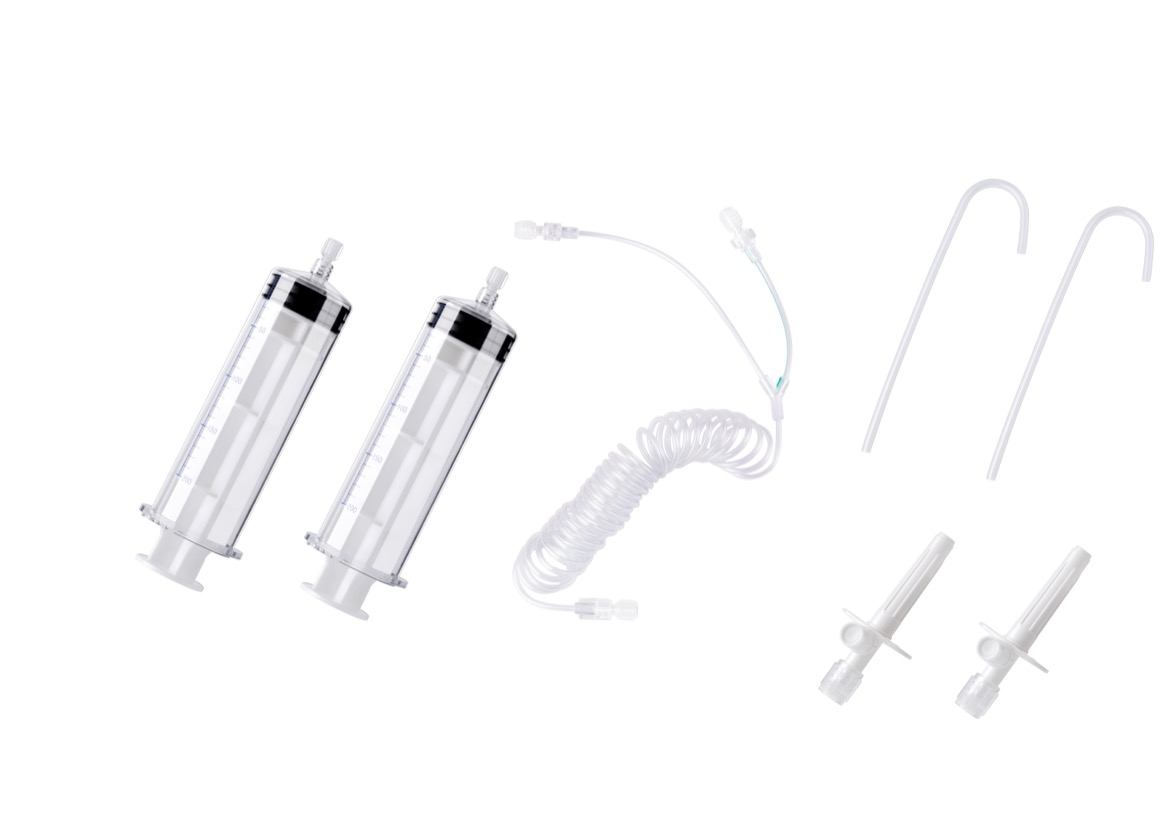
A CT contrast injector syringe kit supplies some or all of the disposable fluid-path components used with a compatible power injector. Kit contents vary by injector model, supplier, and intended workflow.
A dual-syringe configuration typically provides separate syringes for contrast medium and saline. A single-syringe kit serves the corresponding single-syringe system.
| Component | Primary function | What buyers should verify |
|---|---|---|
| High-pressure syringe | Holds fluid and interfaces with the injector drive | Injector model, capacity, mounting geometry, and pressure rating |
| Patient connection tubing | Carries fluid toward the patient connection | Length, internal diameter, pressure rating, and connectors |
| T-connector or branching assembly | Joins contrast and saline pathways where specified | Branch arrangement, valve design, and intended flow direction |
| Filling spike or transfer accessory | Transfers fluid from a compatible source container | Container interface, venting configuration, and permitted use |
| Protective caps | Protect designated interfaces before use | Packaging configuration and handling instructions |
Not every kit contains every item. A purchase order should identify the exact kit code and bill of materials rather than relying on a photograph.
A CT power injector syringe must interface correctly with the injector's mounting and drive mechanisms. Barrel geometry, flange design, piston configuration, and engagement features are therefore important.
Matching nominal syringe capacity does not establish interchangeability. Two syringes can hold the same volume yet use different installation interfaces.
Ask suppliers to identify the exact injector models supported by each product code. "Compatible with major brands" is not sufficiently specific for procurement approval.
Syringe capacity determines available fluid volume, but it does not independently establish a suitable injection protocol.
The syringe's labeled pressure limit must be considered alongside the ratings and restrictions of the tubing, connectors, vascular access device, and injector.
A higher-rated syringe does not increase the permitted operating limit of a lower-rated component elsewhere in the pathway. Clinical staff must follow the applicable device instructions and institutional protocols.
A clear barrel supports visual inspection during preparation, but transparency alone does not establish material suitability or manufacturing quality.
Request documentation addressing intended fluid compatibility, relevant biological evaluation, sterilization, and shelf life. These characteristics should be supported for the finished device, not assumed from a generic material name.
CT injector connection tubing must be intended for the relevant power-injection application. A physically matching connector does not demonstrate that ordinary extension tubing is suitable.
Buyers should verify:
- Labeled pressure rating and operating restrictions.
- Tubing length and internal diameter.
- Connector type and locking arrangement.
- Presence and orientation of valves, where applicable.
- Compatibility with the specified injector assembly.
Pressure ratings describe device limits under specified conditions. They are not recommended clinical settings.
Tubing length affects routing between the injector and patient connection. Excess length may complicate handling, while insufficient length can create tension during positioning or table movement.
Internal diameter and length also influence fluid resistance and the volume contained in the line. Narrower or longer tubing can increase resistance under otherwise comparable conditions.
The practical purchasing question is therefore not "Which tubing is longest?" It is "Which documented configuration supports our equipment layout and intended protocol?"
In specified dual-syringe systems, a T-connector joins the contrast and saline branches into a shared patient pathway.
Some assemblies incorporate check valves to control flow direction. Their location and function depend on the design.
Do not assume that every branching connector contains valves, or that a check valve makes a single-use assembly suitable for multiple patients. Permitted use must come from the applicable labeling.
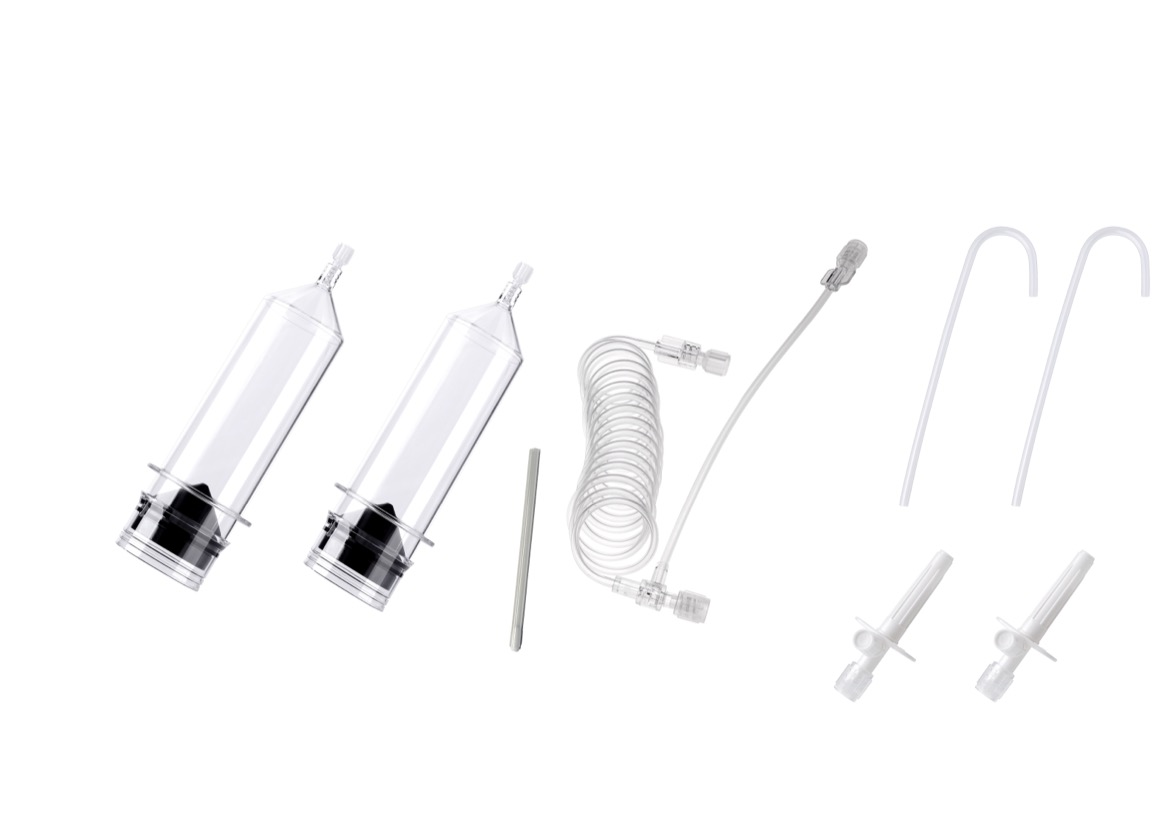
A filling spike accesses a compatible contrast or saline container during preparation. Depending on the design, it may connect directly or form part of a transfer assembly.
Container compatibility matters. Bottle closures, bags, and other source containers do not necessarily use interchangeable access arrangements.
Vented and nonvented designs also serve different configurations. Buyers should confirm the specified container type and follow the filling accessory's instructions rather than choosing by appearance.
Some CT contrast injector syringe kits include transfer tubes or alternative filling devices.
These accessories should be evaluated as part of the preparation pathway. Important questions include:
- Which source containers are supported?
- Is the accessory intended for one filling event or another explicitly labeled workflow?
- How are exposed connection points protected?
- What handling and disposal instructions apply?
Do not substitute an accessory merely because its connector attaches. Connection fit is only one part of suitability.
Single-syringe kits support the corresponding injector configuration. Dual-syringe kits provide separate reservoirs, commonly for contrast and saline.
A dual-syringe system can support contrast administration followed by saline when prescribed by the clinical protocol. However, the presence of two syringes does not establish the appropriate dose, flow rate, or timing.
| Selection issue | Single-syringe kit | Dual-syringe kit |
|---|---|---|
| Syringe arrangement | One injector syringe | Two injector syringes |
| Fluid-path configuration | Usually a simpler pathway | Separate branches joining where specified |
| Procurement focus | Syringe and connection compatibility | Both syringes, branch connections, and complete assembly |
| Clinical programming | Determined by the approved protocol | Determined by the approved protocol, including saline phases where used |
Consumable selection supports the protocol; it does not replace clinical judgment.
A useful purchasing review follows fluid from the source container through the filling accessory, syringe, tubing, connectors, and patient connection.
For each interface, record the product code, intended connection, operating restrictions, and supporting document.
This approach helps identify mismatches that can remain hidden when syringes and tubing are purchased separately. It also makes an approved configuration easier to reproduce across departments.
Tubing contains fluid even before delivery reaches the patient. This internal volume matters when assessing preparation requirements and remaining fluid.
For illustration, a line with an internal volume of 5 mL requires 5 mL of fluid simply to occupy that line. This hypothetical example is not a MAIWEI product specification or a dosing recommendation.
Request documented priming-volume information where available. Clinical teams should determine how it affects their specific preparation and injection workflow.
Unit price does not capture every purchasing consequence.
A practical evaluation can include:
- Kit acquisition cost.
- Additional accessories purchased separately.
- Preparation time.
- Fluid discarded during preparation.
- Expired or unusable inventory.
- Staff training and product-change requirements.
These are suggested evaluation categories, not claims that one kit will produce guaranteed savings. Measure them locally before drawing conclusions.
This overview is a checking framework, not an operating procedure. Preparation and administration must follow the injector instructions, consumable labeling, and institutional policy.
1. Verify that every component matches the approved injector configuration.
2. Check packaging integrity, expiry information, and product identification.
3. Prepare the assembly using the required aseptic technique.
4. Inspect connections and clear air according to the applicable instructions.
5. Confirm that the vascular access device is suitable for the prescribed power injection.
6. Route tubing without kinks, excessive tension, or interference with table movement.
7. Apply the institution's monitoring, response, and disposal procedures.
Air management deserves particular attention. A clear syringe does not eliminate the need to inspect tubing, branches, and connection points.
Likewise, pressure-compatible consumables do not establish that a patient's catheter is suitable for power injection.
ISO 13485 concerns a medical-device quality management system. Certification can support supplier evaluation, but it does not independently demonstrate that every product is compatible with every injector.
Review the certificate's scope, covered manufacturing site, validity, and issuing organization.
A 510(k) clearance is not the same as establishment registration, and "FDA certified" is not an appropriate substitute for a device-specific regulatory description.
For applicable products, request the relevant clearance number and verify the device identity and scope. For CE-marked products, request the applicable declaration of conformity and supporting documentation.
Do not assume that documentation for one product automatically covers a manufacturer's entire catalog.
Useful supplier records include:
- Product specifications and instructions for use.
- Lot identification and labeling examples.
- Sterilization and shelf-life documentation.
- Packaging information.
- Complaint-handling contacts.
- Notification procedures for relevant product changes.
For distributors and OEM partners, change notification is especially important because a modification may affect existing technical files, labeling, or customer approvals.
MAIWEI INC. develops and manufactures consumables for CT, MRI, and angiographic high-pressure injection applications, including syringes, connection tubing, and related accessories.
According to company-provided information, MAIWEI serves customers in more than 60 countries and regions and reports ISO 13485 certification, CE-marked products, and FDA 510(k) clearances. Product-specific applicability should be verified during qualification.
For a targeted quotation, send MAIWEI your injector manufacturer and model, required syringe capacity, tubing configuration, destination market, and expected order volume.
Request the matching product codes, compatibility documentation, applicable regulatory records, and evaluation samples before final approval.
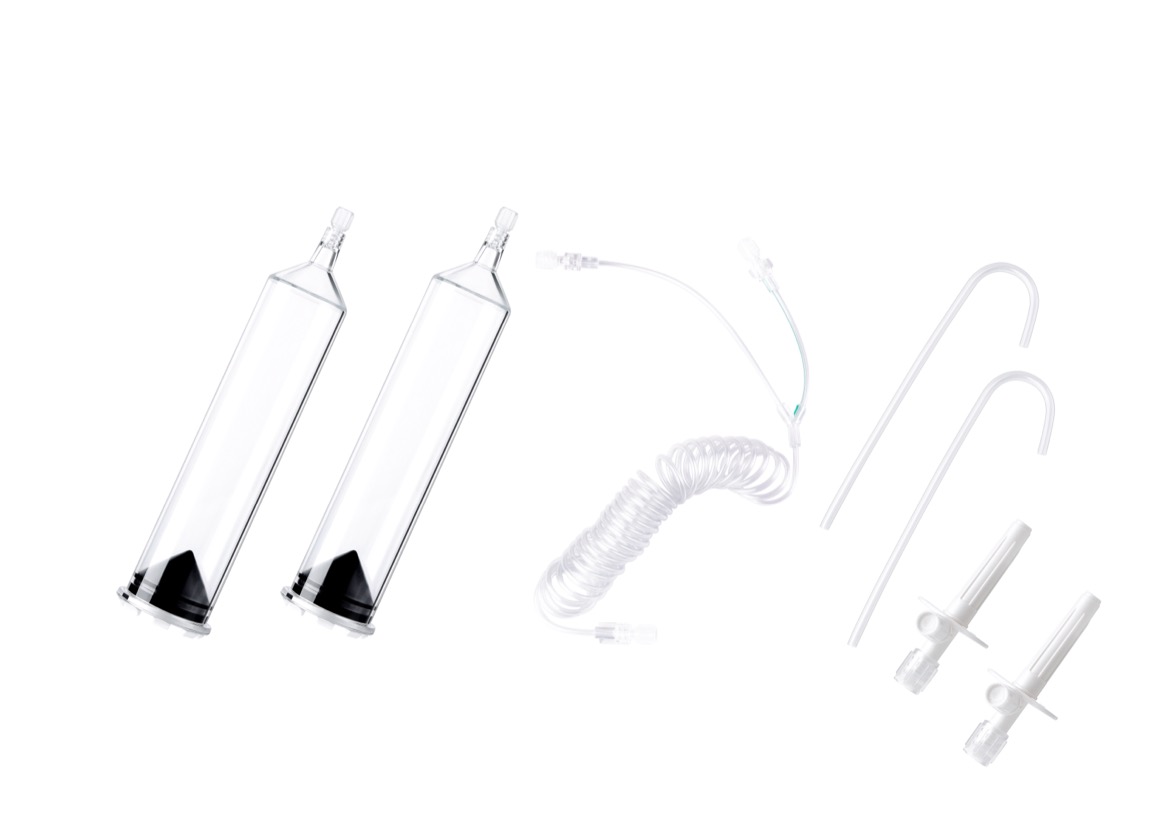
It is a set of consumables intended for use with a compatible CT power injector. Depending on the product code, it may contain syringes, patient tubing, branching connectors, and filling accessories.
No. Compatibility depends on the injector model and complete kit configuration. Matching syringe capacity or connector appearance is insufficient. Obtain written, product-specific compatibility information.
Do not assume so. Replacement tubing must be intended and labeled for the relevant power-injection application, with suitable pressure limits, connections, and operating conditions.
A filling spike accesses a compatible source container during preparation. Patient tubing carries fluid toward the patient connection. Their functions and permitted uses are different.
No. Changing tubing does not authorize reuse of a single-use syringe. Specialized systems with different labeled workflows must be assessed separately; their instructions cannot be applied to ordinary single-use kits.
Start with the intended injector models, destination markets, kit contents, and labeling requirements. Then define performance specifications, packaging, traceability, documentation responsibilities, and change-control arrangements.
1. Bayer. "Syringes & Disposables." Manufacturer information illustrating model-specific syringe kits, tubing, connectors, and filling accessories. [View source]. [radiologysolutions.bayer]
2. American College of Radiology. "ACR Manual on Contrast Media." Professional guidance covering contrast administration and injection-related considerations. [View source]. [acr]
3. American College of Radiology and Society for Pediatric Radiology. "Practice Parameter for the Use of Intravascular Contrast Media." Guidance on protocols and vascular-access suitability. [View source]. [gravitas.acr]
4. Centers for Disease Control and Prevention. "Preventing Unsafe Injection Practices." Guidance on aseptic preparation and single-use syringe safety. [View source]. [cdc]
5. International Organization for Standardization. "ISO 13485 — Medical Devices." Explanation of medical-device quality management requirements and certification context. [View source]. [iso]
6. U.S. Food and Drug Administration. "Are There 'FDA Registered' or 'FDA Certified' Medical Devices?" Explanation of registration, clearance, and approval distinctions. [View source]. [fda]
7. U.S. Food and Drug Administration. "510(k) Premarket Notification Database." Resource for checking device-specific clearance records. [View source]. [accessdata.fda]