


close
Choose Your Site
Global
Social Media
Views: 289 Author: Maiwei Biotech Publish Time: 2026-10-02 Origin: Site


Content Menu
● What the 2023 company list misses
● Which contrast injector suppliers should buyers know?
>> CT, MRI and angiography are not interchangeable
● Why consumables deserve equal attention
● How to verify injector compatibility before ordering
>> A concrete model-level example
● What regulatory documents actually establish
● Single-use and multi-patient workflows
● A sample evaluation plan for buyers
● Where MAIWEI fits in the supply chain
>> What is a contrast media injector?
>> Can one syringe be used across all injector brands?
>> Are CT and MRI injector consumables interchangeable?
>> Does ISO 13485 prove a syringe fits my injector?
>> Does a 510(k) clearance cover all MAIWEI products?
>> What should I ask for before placing an OEM order?
Choosing a contrast media injector company is only the beginning of a reliable CT, MRI or angiography supply program. The injector determines how contrast and saline are delivered, but the syringe, connecting tube and other disposables determine whether a particular setup can be assembled and used as intended. For hospitals and distributors, the useful question is not simply "Who are the biggest manufacturers?" It is "Which documented injector-and-consumable combination fits our equipment, procedures and local requirements?"
This guide reviews prominent injector suppliers, then explains how to evaluate compatible consumables. It is written from a procurement and product-selection perspective, not as a revenue ranking or a substitute for clinical instructions.
An earlier industry article named ten companies and placed corporate revenue figures beside them. That format offers a quick introduction, but company-wide revenue does not measure contrast injector sales. It also tells a buyer little about the model installed in a specific imaging suite.
Three gaps matter more in day-to-day purchasing:
- The product is not just the injector. Syringes, tubing, spikes, transfer sets and patient lines may have separate specifications and replacement schedules.
- A brand name is not a compatibility statement. The relevant evidence identifies the exact injector model, consumable model and intended use.
- Markets and workflows have moved on. Multi-patient, rapid-exchange and syringeless systems need different questions from conventional single-use syringe systems.
A more useful supplier review therefore starts with the installed fleet and the procedure mix. It then works outward to the disposable components, supporting documents and supply plan.
The companies below illustrate different positions in contrast delivery. This is not a market-share ranking. Portfolios and regional availability can change; confirm the product offered in your country before building a tender around it.
| Company | Illustrative injector offering | Procurement question to ask |
|---|---|---|
| MAIWEI | Compatible syringes, pressure connecting tubes and related disposables | Which exact MAIWEI model is documented for the buyer's injector and market? |
| Bayer | MEDRAD Stellant and Centargo CT systems | Which disposable configuration applies to the exact system and local labeling? |
| Bracco Imaging | EmpowerCTA+ CT system | Is the quoted pack a single- or dual-syringe configuration, and what tubing does it include? |
| Guerbet | OptiVantage CT and OptiStar Elite MRI systems | Which dedicated disposables and syringe formats are specified? |
| GE HealthCare | Injector offerings and distribution arrangements | Who manufactures and supports the specific injector being quoted? |
| Nemoto Kyorindo | CT, MRI and angiography injector lines | Which model generation is installed, and what is its documented accessory list? |
| ulrich medical | CT motion and Max MRI systems | Does the system use syringes, or dedicated pump tubing, cassettes and patient tubing? |
| MEDTRON AG | Accutron CT, MR and angiography systems | Which procedure-specific disposable set is required? |
MAIWEI belongs in a different category from an injector-platform manufacturer: its relevant offer here is the consumable supply. Keeping that distinction clear helps buyers compare like with like. A hospital selecting a new injector may prioritize workflow and service. A distributor sourcing replacement kits must also establish model-level fit, packaging, documentation and repeat supply.
A contrast-enhanced CT room may use a single- or dual-syringe setup, or a syringeless system with its own tubing arrangement. MRI introduces a different injector environment and often different syringe capacities and set configurations. Angiography can involve different pressure requirements and connections.
Never use "high-pressure syringe" as a universal compatibility label. A syringe that fits one injector does not automatically fit another model from the same brand. A connecting tube should not be selected by length alone, nor should its pressure rating be inferred from the syringe beside it. Review the complete fluid path against the applicable instructions for use.
Injector hardware may remain in service for years. Consumables, by contrast, are reordered as procedures are performed and as approved replacement intervals require. Their specifications affect purchasing, inventory and setup at every site.
A typical evaluation covers:
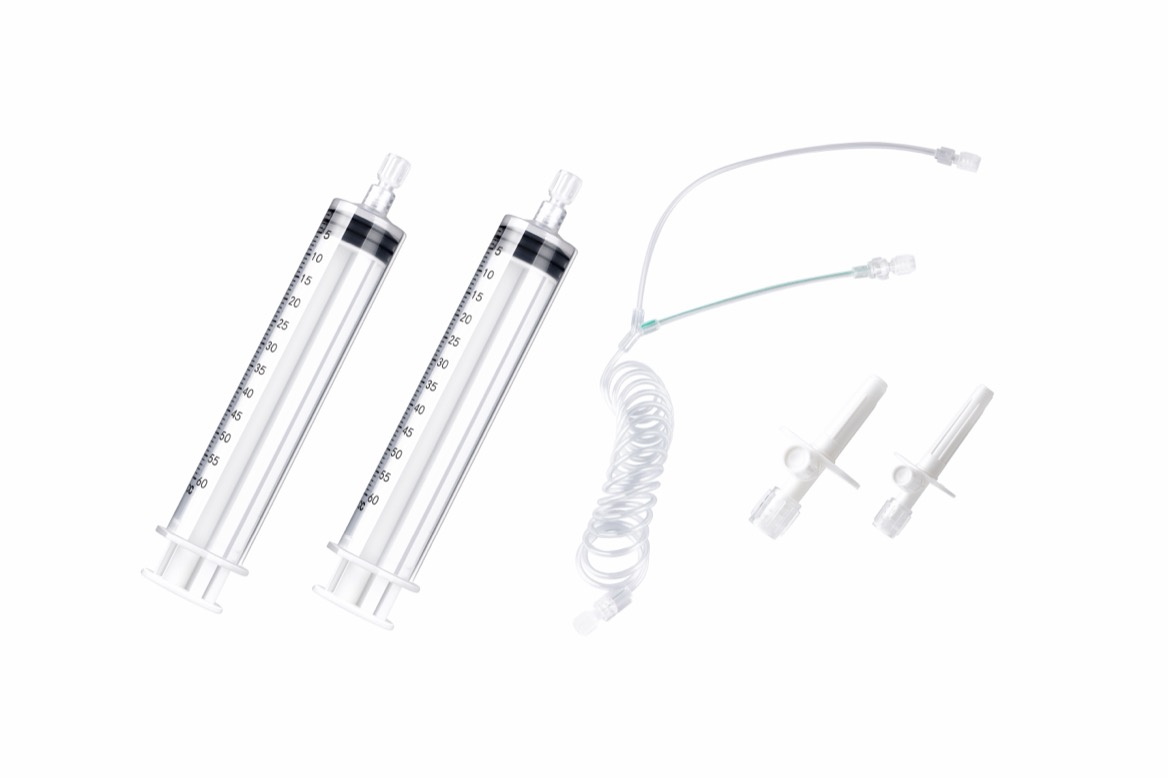
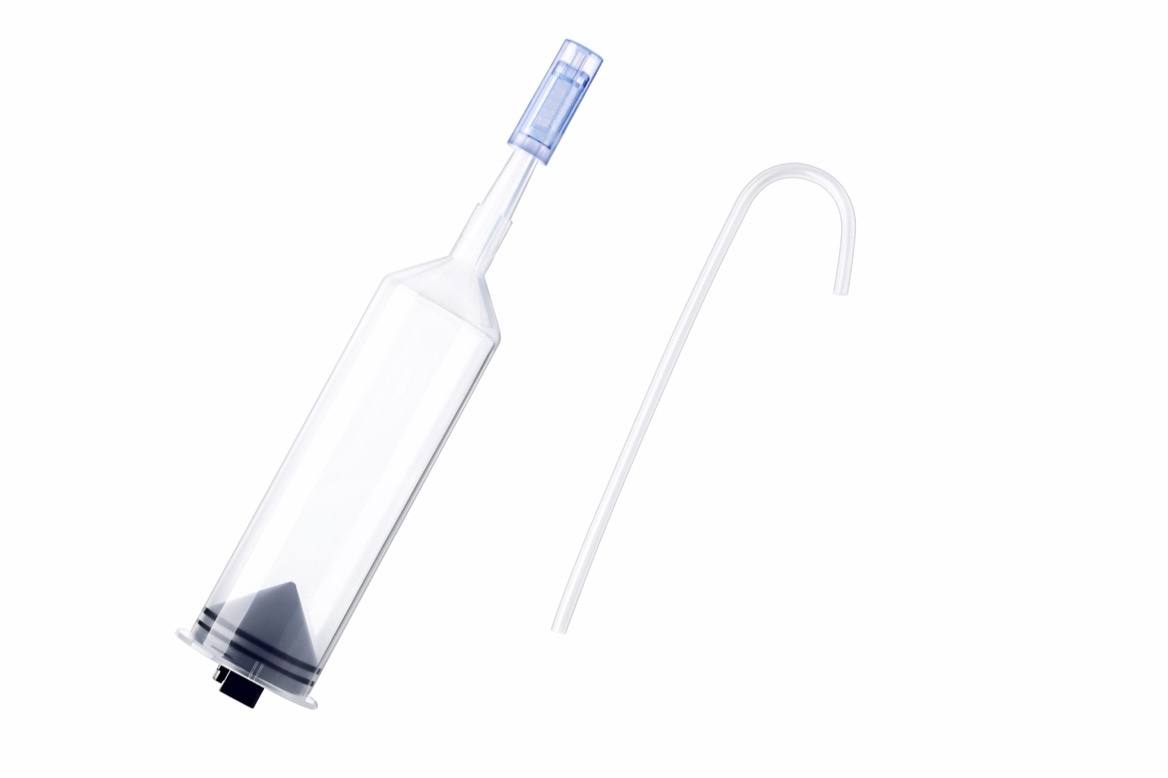
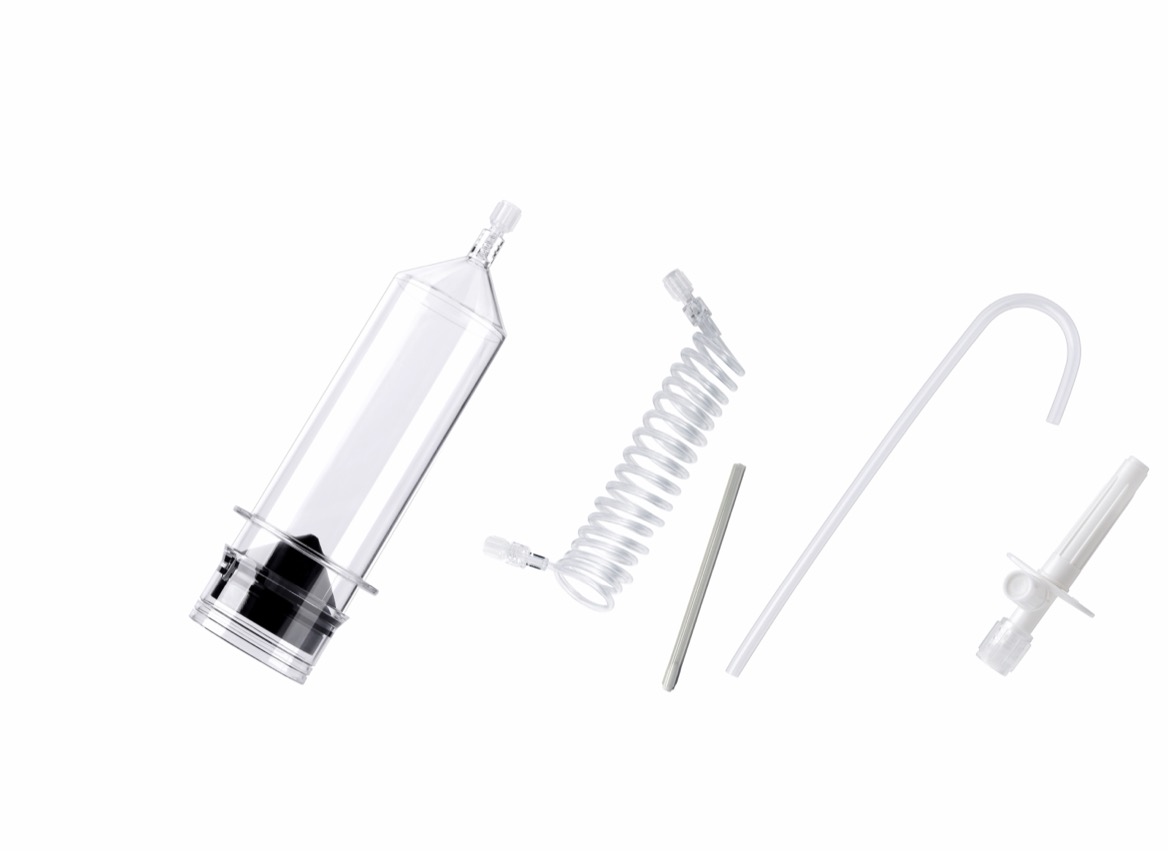
- Syringes: Capacity, single- or dual-head configuration, injector interface and stated pressure limit.
- Pressure connecting tubes: Length, straight or coiled form, connector configuration and pressure limit.
- Spikes and fill components: Intended role in drawing contrast or saline and the compatible set configuration.
- Transfer and patient lines: Placement in the fluid path, connection design and replacement instructions.
- Packaging: Sterility status, labeled shelf life, lot identification and integrity on receipt.
These details should be checked as a complete combination, not as isolated catalog features. For example, a dual-head CT injector may need two syringes and a specified Y-tubing arrangement. Ordering two correctly sized syringes but the wrong connecting set does not produce a validated setup.
The reverse is also true: a familiar-looking connector does not establish that the whole assembly is suitable for an injector. Ask the supplier to identify precisely what has been assessed and what remains outside the stated compatibility claim.
A practical review begins with a short list of facts gathered from the imaging department. It should end with a documented decision for each proposed stock-keeping unit, rather than a general assurance that it "works with major brands."
1. Record the installed injector. Capture the manufacturer, full model name, model generation and any relevant system configuration. If several hospitals use different versions, list them separately.
2. Define the examination and setup. Identify CT, MRI or angiography use; single- or dual-head operation; and the required syringe, tube, spike or kit arrangement.
3. Match exact product codes. Request the proposed consumable model numbers and a compatibility statement that names the corresponding injector models.
4. Compare the fluid path. Check capacity, pressure limits, tubing length, connector type and all components used together. Do not assume the highest rating of one part applies to the whole assembly.
5. Review the instructions for use. Confirm intended use, preparation, single-use status, warnings and any limitations relevant to the destination market.
6. Assess samples under site procedures. Have authorized personnel evaluate fit and setup against the manufacturer's instructions before approving routine purchasing.
This process does not ask a purchasing team to make a clinical judgment. It gives clinical, biomedical and procurement colleagues a shared specification so that each can review the part within their responsibility.
The published clearance summary for Shenzhen Maiwei Biotech's K253048 does not merely say that its syringes are "widely compatible." It lists individual syringe models, capacities, pressure limits and corresponding injector models. For example, it identifies a 200/200 mL, 350 psi syringe model for a specified Stellant-D system, while separately listing 150 mL, 1200 psi configurations for specified angiographic systems.
That distinction is commercially important. "Compatible with Stellant" is a starting point for an inquiry; it is not a complete purchase specification. A buyer should still confirm the exact part number, the injector model on site, the associated accessories and the current instructions for use. The published summary itself directs readers to those instructions for the complete compatible-device list.
Supplier documents answer different questions. Treating them as interchangeable can create an avoidable gap in a tender review.
| Document or claim | What it helps establish | What it does not establish by itself |
|---|---|---|
| ISO 13485 certificate | A quality-management-system scope for medical-device activities | Compatibility of every catalog item with every injector |
| CE marking and supporting documents | The product's stated European conformity route | Automatic authorization in another market |
| FDA 510(k) clearance | A decision for the identified device and indications for use | Clearance of an entire company's product range |
| Compatibility statement or instructions for use | Identified models, configuration and use limitations | Suitability for unlisted equipment or modified setups |
| Test and traceability records | Evidence relevant to specified performance and production controls | Permission to disregard the product label |
For MAIWEI-related U.S. sourcing, K253048 is a useful document to request by number. The public record names Shenzhen Maiwei Biotech Co., Ltd. as the applicant and identifies high-pressure syringes, pressure connecting tubes, spikes, transfer tubes and quick-fill tubes. The cleared devices are described as sterile and single-use for their stated indications.
Use precise language in sales copy: say "FDA 510(k)-cleared devices under K253048," where that record applies, rather than "FDA-approved company" or "all products FDA-certified." Similarly, ask for the current ISO certificate, its scope, and the relevant European product documentation instead of assuming one certificate covers every proposed kit.
Recent product development has put more attention on throughput. Multi-patient CT systems and rapid-exchange or syringeless designs aim to reduce repetitive setup steps. Yet they do not make all tubing reusable or remove the need to distinguish one fluid-path component from another.
The key question is which component may remain in use, for whom, and for how long under that product's labeling. Some systems specify a longer-use pump set or cassette alongside a patient line that is changed for each patient. A conventional single-use syringe kit has a different use pattern. Never transfer the replacement schedule from one system to another because both are described as "multi-patient."
For a high-volume department, compare workflows using the actual procedure sequence:
- How many steps are required to prepare the first examination?
- Which labeled components change between patients?
- How are lots and patient-use records captured?
- What training is required for a new setup?
- What happens when a component is unavailable mid-shift?
These questions can reveal costs and operational friction that a unit-price comparison misses. They also help a distributor quote the correct combination of components rather than an attractive but incomplete kit.
Before committing to a volume order, ask suppliers for a small, clearly identified evaluation batch. Do not substitute an undocumented field trial for the site's approval process. Instead, agree in advance on the checks and the people responsible for them.
For an illustrative hospital with two CT injector models, an MRI injector and one angiography suite, the assessment could proceed as follows:
1. Create a fleet matrix with each injector's complete model designation.
2. List the currently specified consumables and proposed alternatives by part number.
3. Obtain labeling, compatibility information, applicable regulatory documents and sample lot details.
4. Have the appropriate site team review physical fit, preparation steps and the stated operating limits.
5. Record questions and any failed checks by part number—not simply by supplier name.
6. Approve, reject or request further evidence for each proposed item independently.
A distributor can adapt the same matrix for multiple customers. If one hospital operates a different injector generation, it receives a separate compatibility decision. This makes quotations more useful and reduces the risk of assuming that a product approved for one account will suit the next.
MAIWEI INC. presents itself as a supplier of CT, MRI and angiography injector consumables for hospitals, distributors and OEM partners. Its portfolio includes high-pressure syringes, pressure connecting tubes and related components intended to support a range of established injector platforms.
For a prospective buyer, the strongest conversation is model-specific. Send MAIWEI the injector make and full model, modality, required kit components, destination market and expected ordering volume. Request the proposed product codes, current instructions for use, compatibility documentation, applicable quality and regulatory documents, and evaluation samples. If you need an OEM arrangement, add packaging, labeling and traceability requirements to that request.
This approach makes room for a meaningful supplier assessment without implying that every MAIWEI product fits every device. It also gives the manufacturer enough detail to recommend a documented configuration rather than a generic syringe.
Ready to assess a compatible supply option? Share your installed injector models and required CT, MRI or angiography kit configuration with MAIWEI. Ask for a model-specific recommendation and documentation package before requesting a volume quotation.
It is a powered system used to deliver contrast media, and in relevant protocols saline, during imaging procedures such as CT, MRI or angiography. The compatible disposable fluid-path components depend on the system and its intended use.
No universal fit should be assumed. Confirm the exact syringe model and injector model in the product documentation. Even within one brand, different systems may require different capacities, interfaces or accessories.
Not by default. The modality, injector design, prescribed set and labeled specifications all matter. A supplier should identify the approved or documented configuration rather than rely on a broad "CT/MRI" description.
No. ISO 13485 concerns the manufacturer's quality-management system. Product-level compatibility still requires the appropriate model-specific documentation and review.
No. A clearance applies to the identified devices and stated indications. For U.S. purchasing, check whether the specific product being offered is covered by the relevant record and instructions for use.
Provide the target injector models, intended markets, kit configuration and projected volumes. Then request product codes, compatibility evidence, applicable regulatory documentation, labeling details, sample-evaluation arrangements and the proposed traceability process.
- Emergen Research, "[Top 10 Companies in Contrast Media Injectors Market in 2023]." Original article used to identify the company-list format and its information gaps. [emergenresearch]
- Fortune Business Insights, "[Contrast Media Injectors Market Size, Share & Industry Analysis]." Market segmentation and discussion of consumables and newer injector formats; no revenue ranking from this report is reproduced here. [fortunebusinessinsights]
- U.S. Food and Drug Administration, "[510(k) record K253048]" and "[K253048 clearance letter and summary]." Applicant, device scope, indications, model-level compatibility and specifications. [accessdata.fda]
- U.S. Food and Drug Administration, "[Search the Releasable 510(k) Database]" and "[Device Approvals and Clearances]." Verification method and regulatory terminology. [fda]
- International Organization for Standardization, "[ISO 13485:2016]." Quality-management-system standard and scope. [iso]
- European Commission, "[Manufacturers of Medical Devices]." European manufacturer obligations and conformity context. [health.ec.europa]
- American College of Radiology, "[Manual on Contrast Media]." Clinical reference for contrast administration and related practice topics. [acr]
- Manufacturer product information: [Bayer MEDRAD Centargo], [Bracco EmpowerCTA+], [Guerbet OptiVantage], [Nemoto Kyorindo injector range], [ulrich medical disposables] and [MEDTRON product catalogue]. Product examples and distinctions between disposable formats. [radiologysolutions.bayer]
- MAIWEI, "[Company website]" and "[About Us]." Company positioning and portfolio descriptions; company claims should be checked against current product documents before publication. [maiweiusa]