
Views: 257 Author: Maiwei Biotech Publish Time: 2026-11-18 Origin: Site


Content Menu
● How Flow Rate and Pressure Work Together in CT Power Injection
>> Flow rate controls how quickly the bolus is delivered
>> The pressure limit is a ceiling, not a delivery target
● What Changes the Pressure Required at the Same Flow Rate?
>> Contrast viscosity matters more than concentration alone
>> Tubing and vascular access can be the limiting components
● How to Select a Compatible CT Power Injector Syringe Kit
● Three Checks That Catch Problems a Spec Sheet Can Miss
>> 1. Compare injector capabilities with kit-specific limits
>> 2. Review delivered flow in an approved bench evaluation
>> 3. Verify regulatory scope at the catalog-number level
● Request a CT Injector Syringe Compatibility Review
● Frequently Asked Questions About CT Contrast Injector Syringes
>> Does a higher-pressure syringe allow a higher CT contrast flow rate?
>> Are two 200 mL CT power injector syringes interchangeable?
>> Why can actual flow be lower than the programmed flow?
>> Does dual-head injection change the selection process?
>> Can a successful saline test prove compatibility with contrast?
>> Is an FDA 510(k) number enough to approve a substitute?
Selecting a CT contrast injector syringe starts with two questions: Can the assembled injection system deliver the protocol's required flow rate, and can it do so within its documented pressure limits? A syringe may fit the injector and hold enough contrast, yet the selected tubing, contrast formulation, or vascular access device may prevent the system from sustaining the programmed flow. That distinction matters to radiology teams protecting bolus timing and to buyers deciding whether a replacement syringe kit is suitable for their installed equipment.
From a manufacturer's perspective, I would start with the injector model and the complete fluid path, not the pressure value printed on the syringe box. The goal is to select a documented configuration that supports the department's approved protocols—not to buy the syringe with the highest pressure rating.
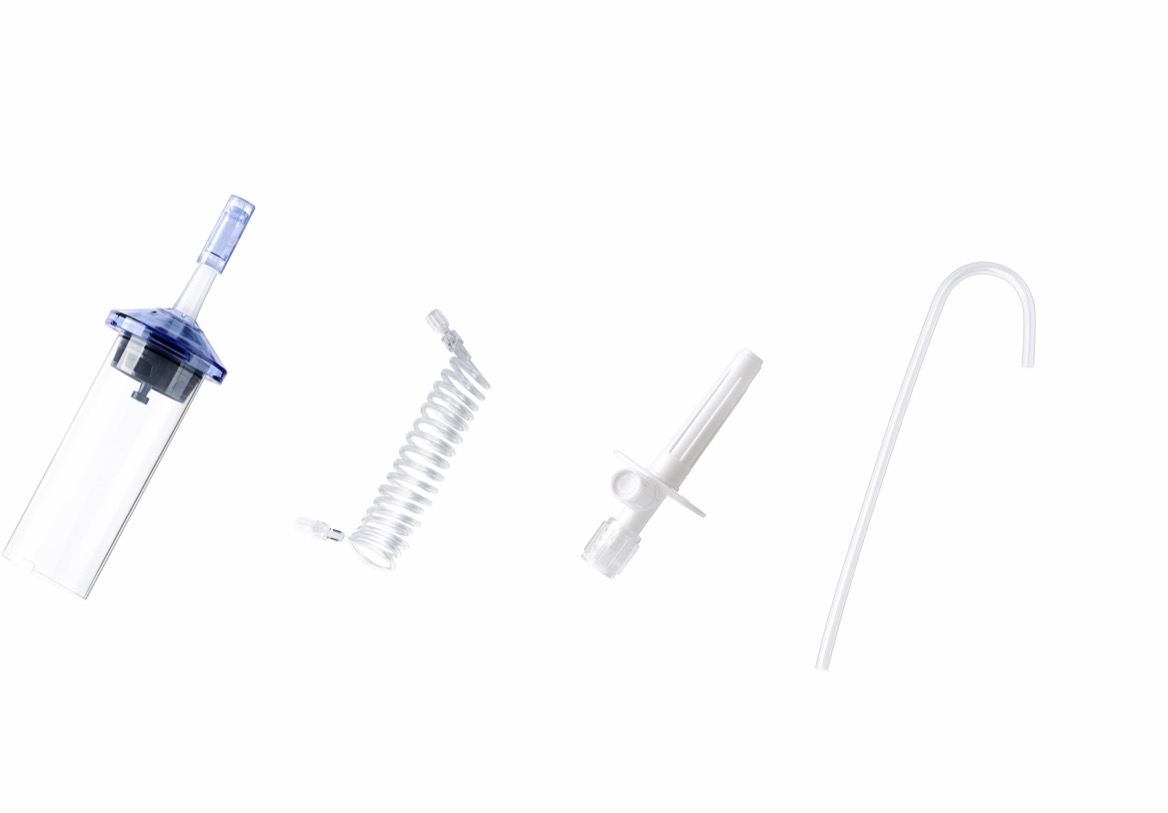
Flow rate is the volume delivered per second, usually expressed in milliliters per second (mL/s). For an illustrative calculation, 80 mL delivered at a steady 4 mL/s takes 20 seconds. If the system can sustain only 3.2 mL/s, the same volume takes 25 seconds, assuming delivery continues to completion. That five-second difference illustrates why the programmed rate and the delivered rate are not interchangeable. These figures explain the arithmetic; they are not patient injection settings.
Iodine delivery rate adds another consideration. It is the amount of iodine delivered per second, calculated by multiplying volumetric flow by iodine concentration. At 4 mL/s, a contrast medium containing 350 mg of iodine per mL delivers 1.4 grams of iodine per second. If actual flow falls, iodine delivery falls even though the concentration is unchanged. Conversely, two contrast products at the same volumetric flow can deliver different amounts of iodine per second and impose different pressure demands.
The injector generates pressure to move liquid through a resistive path. Increasing the flow rate generally increases the pressure required when the fluid and path stay the same. The pressure limit is a programmed boundary, not the pressure the injector must reach during every injection. Depending on the model and its control logic, approaching or reaching that boundary can result in reduced flow, an alert, or interrupted delivery. Check the operating instructions for the exact system.
The syringe's rated pressure, the injector's programmable pressure limit, and the vascular access device's labeled power-injection limits answer different questions. Some devices also specify a maximum flow rate. Do not use a syringe rating as an injector setting or assume that all pressure values refer to the same measurement location. Follow the labeling and instructions for the specific assembly.
| Variable | Why it matters | What to verify before purchase |
|---|---|---|
| Contrast formulation and temperature | Higher viscosity generally requires more pressure at the same flow through the same path. | Evaluate the contrast products and permitted temperature conditions used by the site. |
| Connector tubing and fittings | Internal diameter, length, and localized restrictions can change resistance. | Confirm the exact tubing reference and whether alternate configurations are documented. |
| Vascular access device | Internal dimensions and device-specific limits can constrain flow independently of syringe capacity. | Verify power-injection labeling and the applicable flow and pressure conditions. |
| Injector and syringe interface | Mounting and plunger engagement are specific to the equipment and disposable design. | Match the injector model and syringe reference against current compatibility documentation. |
Viscosity describes a liquid's resistance to flow. Do not infer it from iodine concentration alone: different contrast formulations can have different viscosities even when their iodine concentrations are similar. A published bench study comparing four CT injector systems, five contrast media, and three catheter gauges showed that achievable iodine delivery depended on the combination tested. The contrast was tested at room temperature, so the results should not be read as universal performance figures for warmed contrast or for untested syringe kits.
Warming can reduce viscosity, but it is not a workaround for an unsuitable disposable set. Where a department uses warmed contrast, evaluate the kit under the department's approved conditions, consistent with contrast labeling and local policy. A successful saline-only demonstration does not establish that the same configuration can sustain the required flow with iodinated contrast.
Two kits may contain the same nominal syringe capacity while using different extension lines, connectors, or Y-sets. A narrower internal passage or a longer line can add resistance; an apparent fit at the injector head tells you nothing about those differences. Review the patient line as part of the kit rather than treating it as an interchangeable packaging accessory.
The same principle applies to vascular access. A peripherally inserted central catheter, implanted port, or other access device should not be assumed suitable for power injection based on its category or appearance. Verify the particular device's labeling and the site's approved protocol. An injector pressure reading also does not replace clinical assessment for extravasation, which is leakage of contrast into surrounding tissue.
1. Confirm the exact injector model. Record the manufacturer, model, and relevant configuration. Ask for written compatibility documentation that identifies the proposed syringe and tubing by catalog number. A brand name or the phrase "fits most injectors" is not specific enough for substitution.
2. Map the department's protocol requirements. Record the programmed flow range, contrast and saline phase volumes, and applicable pressure limits. Review the most demanding approved configurations as well as routine ones. A kit that performs well for a routine scan may still need evaluation for a protocol with tighter bolus timing.
3. Choose capacity and kit contents together. Confirm that the designated syringes accommodate the required volumes under the system's instructions for filling and priming. For dual-head models, check the contrast and saline syringes separately. Verify the labeling and intended use of the supplied patient line, transfer components, and other accessories.
4. Compare ratings under the stated conditions. Ask whether each pressure figure is a labeled operating rating, an injector setting, or a result from a bench test. Request the conditions supporting the claim. A pressure result from a different assembly is not evidence that your intended configuration will perform the same way.
5. Approve the configuration before routine use. Have radiology, biomedical engineering, and procurement agree on the documents and acceptance criteria required by the facility. Record the approved catalog numbers so a later tubing or accessory substitution does not bypass the original review.
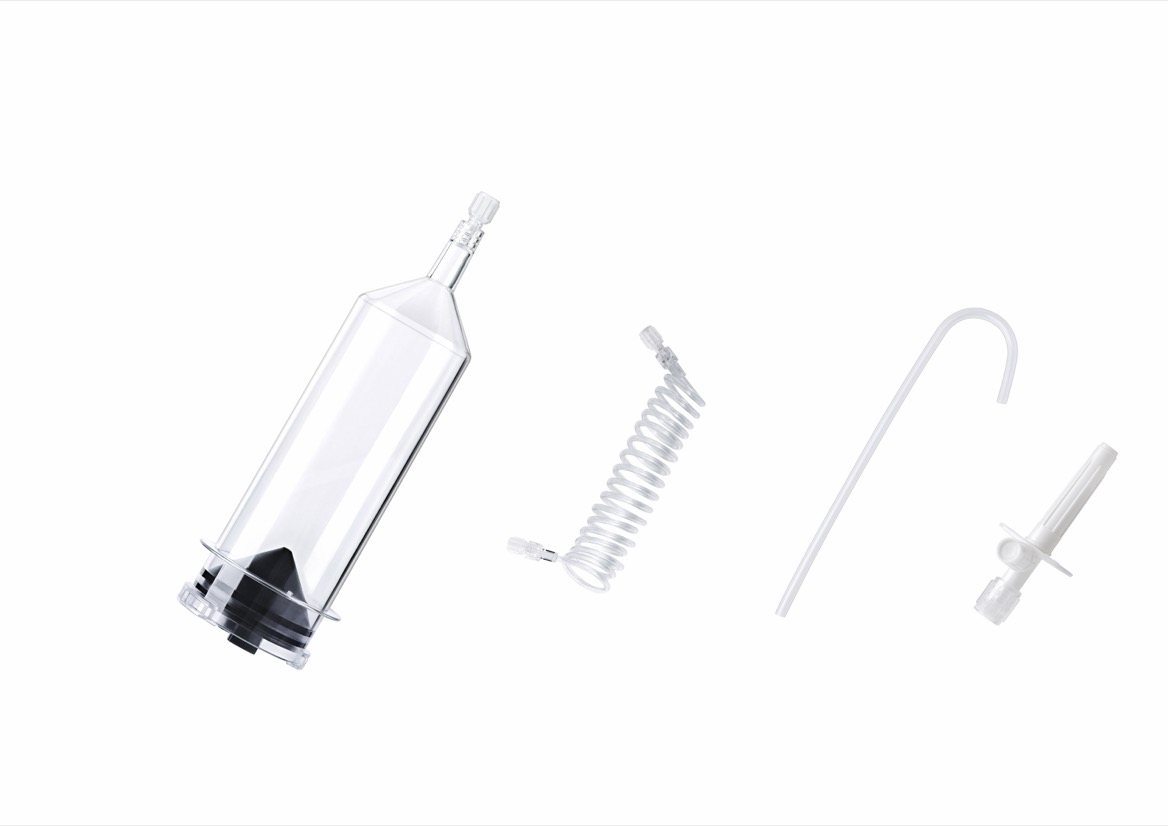
The Bayer MEDRAD Stellant FLEX illustrates why a specification needs context. Bayer lists a programmable flow range of 0.1–10 mL/s and selectable pressure limits up to 325 psi for its 150 mL and 200 mL syringe configurations. These describe options for that system; they do not establish that every selectable flow can be delivered through every fluid path or authorize those settings for a third-party kit. Read the injector specifications alongside the exact consumable and access-device documentation.
Consider a department comparing two kits with identical nominal syringe volumes. Both mount correctly, but one uses a different connector line. In a controlled, non-patient evaluation, the team can compare delivered flow, delivery duration, and pressure behavior under representative approved conditions. If the injector reports pressure limiting with one configuration, the finding warrants investigation; it does not, by itself, identify which component caused the restriction.
Where the equipment supports it, retain the flow and pressure records with the exact kit references and test conditions. This gives the team something concrete to compare if a supplier later changes tubing, connectors, or packaging contents.
Keep quality-system evidence separate from market authorization. ISO 13485 documentation concerns the quality management system. For a CE-marked product, check the applicable declaration and supporting documentation. In the United States, use the term FDA 510(k) clearance, not FDA certification, and verify that the specific device is covered.
The public FDA record K253048 names Shenzhen Maiwei Biotech Co., Ltd. and lists high-pressure syringes, pressure connecting tubes, quick-fill tubes, spikes, and transfer tubes. Buyers should still confirm that the catalog number, labeling, and intended use of the proposed product match the applicable documentation. A public clearance record is a starting point, not a substitute for that check.
MAIWEI INC. develops and manufactures power injector syringes, connecting lines, and related disposables for CT, MRI, and angiography. For a CT compatibility review, send your injector make and model, current syringe and tubing catalog numbers, required capacities, approved flow and pressure ranges, and destination market. Ask for a proposed kit configuration, written compatibility evidence, and SKU-specific regulatory documents before placing a trial or volume order. This gives hospital teams, distributors, and OEM buyers a common basis for evaluation.
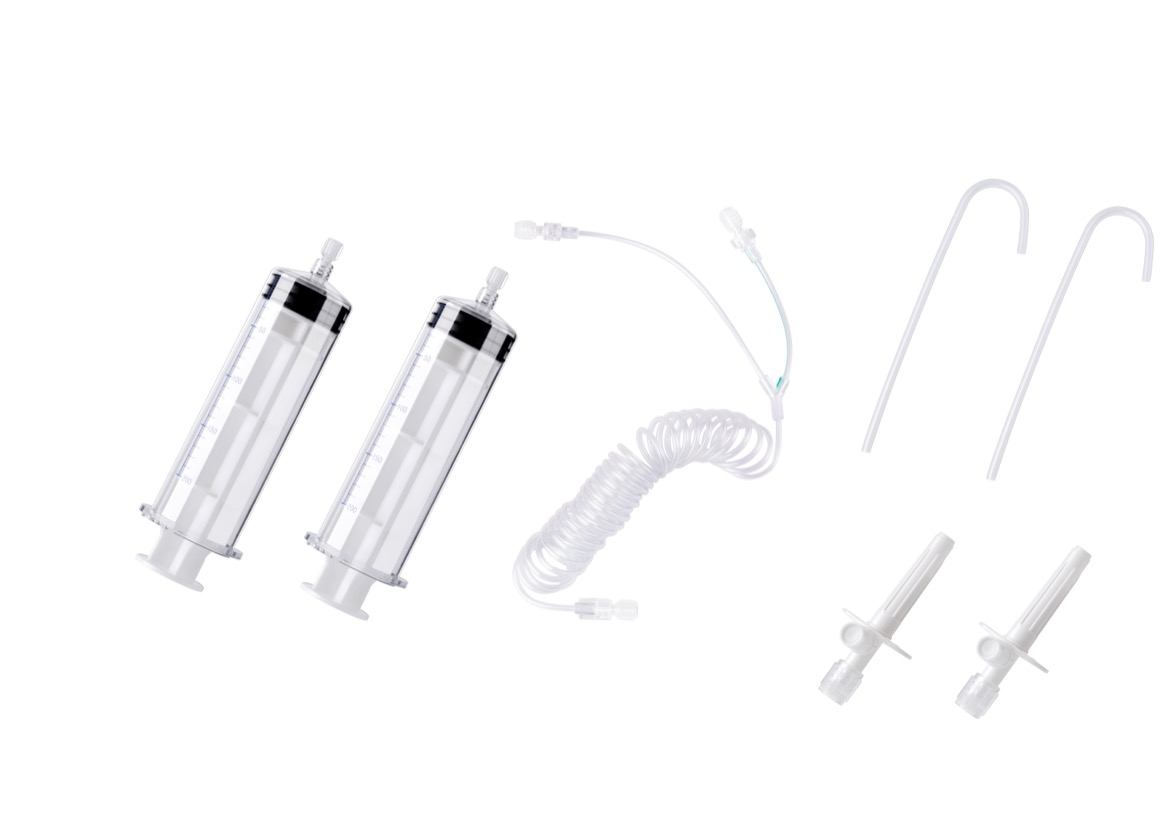
Not necessarily. The injector, connector tubing, contrast viscosity, and vascular access device can each constrain delivered flow. A higher syringe rating neither removes those restrictions nor authorizes changes to clinical settings.
No. Capacity does not establish compatibility. Check the exact injector model, mounting interface, plunger engagement, kit contents, operating limits, and labeling before approving a substitution.
The required pressure can approach the injector's limit before it reaches or sustains the programmed rate. The response is model-specific. Review available injection records and instructions rather than assuming the syringe is defective or raising the limit to compensate.
Yes. Verify both syringes and the shared patient line. The contrast and saline sides can carry fluids with different viscosities and may have different volume needs, so review each phase and confirm that the complete kit supports the intended sequence.
No. It can help evaluate what happens under the test conditions, but saline does not replicate the viscosity of iodinated contrast. A bench evaluation should reflect the approved configuration and representative conditions for the intended use.
No. Verify that the clearance applies to the proposed device and review its intended use, injector compatibility, instructions, and applicable market requirements. Then complete the facility's own substitution review.
- American College of Radiology. *ACR Manual on Contrast Media*. See "Injection of Contrast Media," "Contrast Media Warming," and "Extravasation of Contrast Media" for clinical context. [Read the manual]. [acr]
- McDermott M, et al. (2020). *Impact of CT Injector Technology and Contrast Media Viscosity on Achievable Iodine Delivery Rates and Vascular Enhancement*. Bench evidence on injector design, contrast viscosity, and catheter gauge. [Read the full study]. [pmc.ncbi.nlm.nih]
- Bayer. *MEDRAD Stellant FLEX CT Injection System*. Manufacturer specifications for programmable flow, pressure limits, and syringe configurations. [View the system specifications]. [radiologysolutions.bayer]
- U.S. Food and Drug Administration. *510(k) Summary K192370: MEDRAD Stellant FLEX CT Injection System with Certegra Workstation*. Device description, intended use, and technical comparison. [Read the 510(k) summary]. [accessdata.fda]
- U.S. Food and Drug Administration. *510(k) Premarket Notification K253048: Shenzhen Maiwei Biotech Co., Ltd.* Public record identifying the applicant, listed device categories, and substantial-equivalence decision. [View the FDA record]. [accessdata.fda]

