


close
Choose Your Site
Global
Social Media
Views: 299 Author: Maiwei Biotech Publish Time: 2026-11-03 Origin: Site


Content Menu
● What Does Contrast Leakage Around the Plunger Mean?
● Why Is Contrast Leaking Around the Syringe Plunger? Five Causes to Investigate
>> 1. A Damaged or Inconsistent Plunger Seal
>> 2. Incompatible Syringes or Accessories
>> 3. Incorrect Loading or Incomplete Engagement
>> 4. High Resistance in the Injection Pathway
>> 5. Storage, Expiry, or Handling Problems
● Is It a Plunger Leak, a Connection Leak, or Filling Residue?
● What Should You Do When a Contrast Injector Syringe Leaks?
>> Step 1: Stop the Injection and Assess the Patient
>> Step 2: Handle the System Without Releasing Residual Pressure Unsafely
>> Step 3: Replace the Suspect Disposable
>> Step 4: Preserve Evidence and Report the Event
● How Contrast Viscosity and Temperature Affect Injection Pressure
● A Better Root-Cause Method: Compare the Pattern, Not Just the Syringe
>> Repeated Problems Within One Lot
>> Repeated Problems on One Injector
>> Problems Associated With One Injection Configuration
● What Hospitals and Distributors Should Ask Suppliers
● Choosing High-Pressure Injector Consumables With MAIWEI INC.
>> Is Contrast Leaking Around the Plunger Normal?
>> Can I Continue if the Leak Is Very Small?
>> Does High Injection Pressure Always Cause Plunger Leakage?
>> Can I Lubricate or Reposition the Plunger to Stop Leakage?
>> Does a Plunger Leak Mean the Patient Has Extravasation?
>> Should the Full Contrast Dose Be Repeated After Leakage?
Contrast leaking around the syringe plunger usually indicates that fluid is bypassing the seal between the plunger and the syringe barrel. Possible causes include seal damage, dimensional inconsistency, incompatible consumables, incorrect loading, or excessive resistance elsewhere in the injection pathway. However, contrast spilled during filling can also resemble a plunger leak.
In CT, MRI, and angiography workflows, the priority is safety: stop using a syringe with suspected leakage, assess the patient and injection system, and follow the applicable instructions for use.
From a manufacturing and quality perspective, the most useful question is not simply, "Why is the syringe wet?" It is, "Where did the fluid originate, when did it appear, and under what operating conditions?"
Answering those questions helps teams distinguish a disposable defect from a loading problem, a connection leak, or an injector issue.
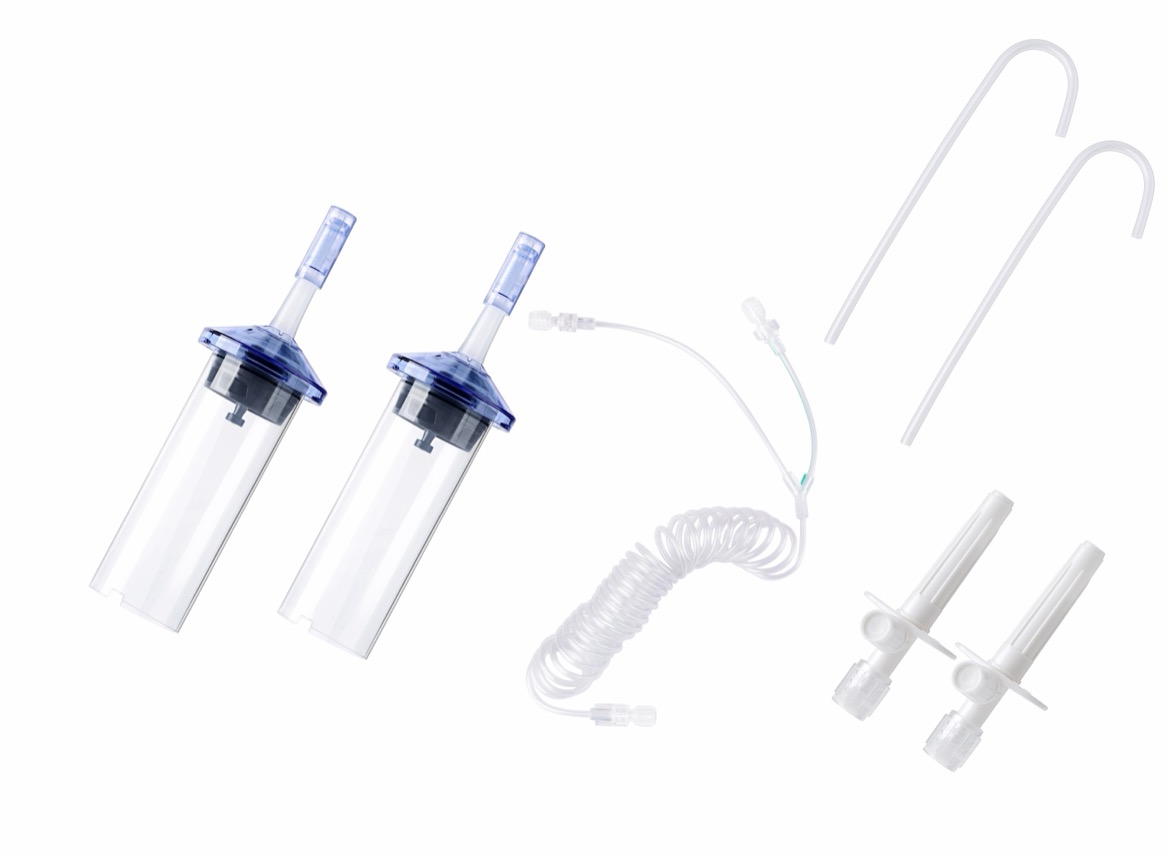
A high-pressure injector syringe depends on a controlled seal between the plunger and the barrel. That seal must allow movement while preventing contrast from escaping backward during the intended injection conditions.
When contrast passes behind the sealing surface, fluid delivery becomes unreliable. The visible amount of leaked fluid does not establish how much contrast reached the patient.
Three situations need to remain distinct:
- Plunger bypass: contrast moves past the seal toward the rear of the syringe.
- External equipment leakage: fluid escapes from a connection, tubing, barrel crack, or another component.
- Contrast extravasation: contrast leaves the blood vessel and enters surrounding tissue at the patient's injection site.
A wet syringe does not, by itself, prove extravasation. Equally, an equipment leak does not remove the need to assess the patient.
A damaged sealing surface may fail to maintain contact with the syringe barrel. Potential contributors include damage during handling, a material defect, or dimensional variation between components.
Visible fluid behind the plunger makes seal bypass an important possibility, but appearance alone cannot identify the root cause.
Manufacturers investigating a complaint may need to examine barrel dimensions, seal geometry, material condition, and retained samples from the same production lot.
Do not remove the plunger, add lubricant, or attempt to repair the seal. Those actions can compromise sterility and alter device performance.
A syringe can appear to fit an injector without being validated for that system.
Compatibility involves more than capacity or external shape. It may depend on:
- Syringe mounting geometry.
- Plunger engagement with the injector drive.
- Barrel support requirements.
- Pressure and flow specifications.
- The complete tubing and connector configuration.
An unsuitable combination can affect fluid delivery and mechanical performance. Identify compatibility through the product labeling and documented device configuration, not a visual comparison.
The same principle applies when sourcing replacement high-pressure injector syringes from an alternative supplier.
Incorrect installation is another possibility to investigate, especially when leakage starts immediately after a consumable change.
Depending on the injector design, incomplete seating or incorrect drive engagement may interfere with intended syringe operation.
Use the model-specific loading procedure. Confirm that the syringe is secured and that all required supports or pressure jackets are correctly installed.
Never force a syringe into position. Repeated loading difficulty should trigger a compatibility check or technical assessment rather than an improvised workaround.
A restricted fluid pathway can increase the pressure required to deliver the programmed flow.
Possible contributors include kinked tubing, a closed clamp, an obstructed component, or a catheter configuration unsuitable for the intended injection.
Higher pressure does not automatically mean that the syringe caused the problem. Conversely, a syringe that leaks only during injection should not be considered acceptable because it remains dry during filling.
Review the complete pathway and its rated operating conditions. Never increase the pressure limit simply to overcome unexplained resistance or continue a leaking injection.
Packaging damage, inappropriate storage, or use beyond the labeled expiry date can undermine confidence in a sterile disposable.
Before use, inspect the packaging and syringe for visible damage, deformation, contamination, and labeling discrepancies.
Storage conditions must follow the manufacturer's instructions. Do not assume that every syringe, seal material, or connector tolerates the same temperatures or chemicals.
An expired or visibly damaged product should not be used to determine whether a leak "happens again."
Leak location provides a useful starting point, although it is not a substitute for technical investigation.
| Observation | Possible explanation | Appropriate response |
|---|---|---|
| Fluid appears behind the plunger seal | Seal bypass or another syringe integrity problem | Stop use and replace the affected disposable |
| Wetness begins at the syringe outlet | Connector leakage, damage, or assembly problem | Inspect the affected connection according to its instructions |
| Fluid tracks along the outside of the barrel | Filling spill or leakage originating elsewhere | Establish the source before proceeding |
| Leakage occurs with a pressure alarm | Pathway restriction, setup issue, or component failure | Stop and review the entire system |
| Pain or swelling develops at the injection site | Possible extravasation | Stop injection and initiate clinical assessment |
Check for residual contrast during preparation, before patient connection when possible. Fluid can run along surfaces and collect near the plunger, creating a misleading appearance.
Do not wipe away new fluid during an active injection and assume the problem has resolved.
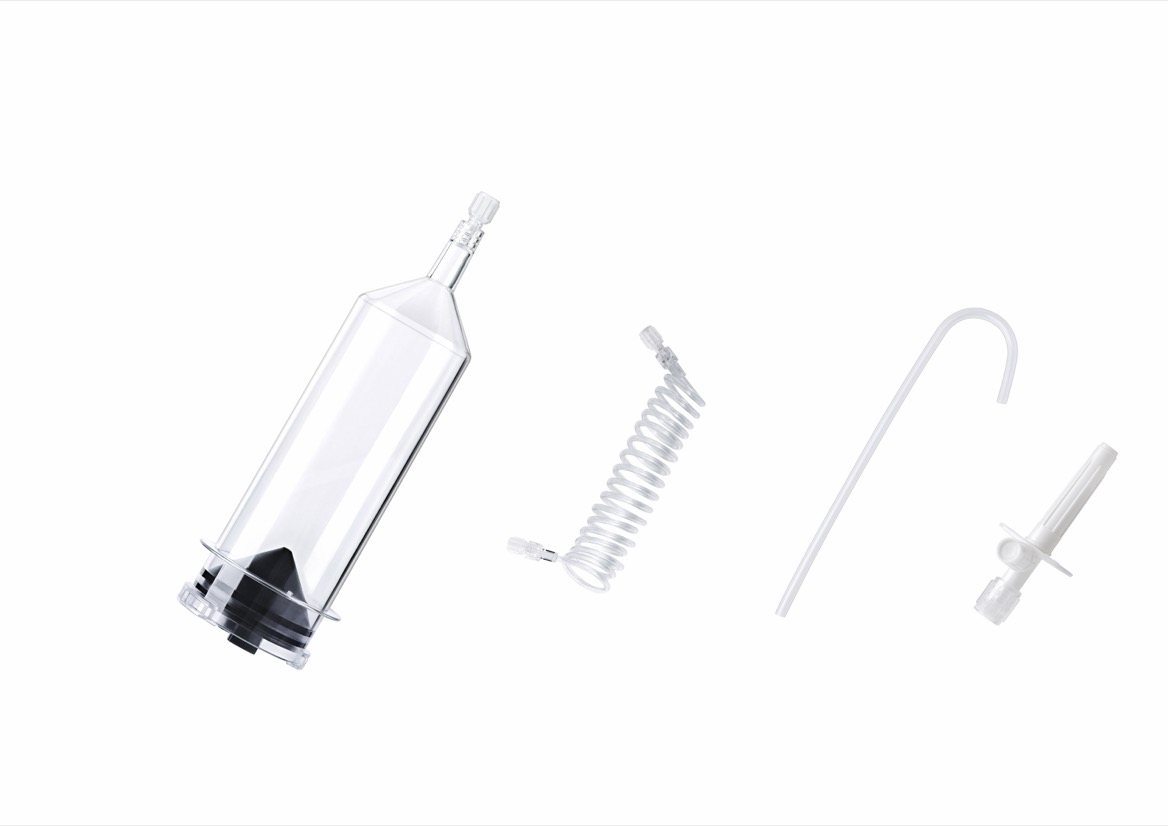
Stop the injection according to the injector instructions and local procedure.
Assess the injection site and patient symptoms. Suspected extravasation, unexpected pain, swelling, or other clinical concerns require the facility's established response.
The radiologist or responsible clinician should decide whether further imaging or contrast administration is appropriate. Do not automatically repeat the original injection.
Follow the manufacturer's procedure for stopping, isolating, and handling the injection system.
Do not loosen a pressurized connection or remove a syringe while pressure may remain in the assembly.
If contrast has entered the injector housing, stop using the affected equipment and obtain the required technical assessment. Surface cleaning alone may not address internal contamination or damage.
Do not continue using a leaking syringe.
Replace the affected syringe and any additional components required by the instructions or contamination assessment. Prepare and prime the replacement system using aseptic technique, with air removed before patient connection.
Changing a disposable does not automatically resolve an underlying injector fault or downstream restriction.
Document the issue before relevant details are lost.
Useful information includes:
- Syringe product code, lot number, and expiry date.
- Injector manufacturer, model, and equipment identifier.
- Contrast product, concentration, and recorded temperature, if available.
- Programmed flow, pressure limit, and delivered-volume display.
- Tubing and catheter configuration.
- Alarm messages, photographs, and patient observations.
Retain the affected components when permitted by infection-control and complaint-handling procedures. Follow applicable reporting requirements.
Contrast viscosity describes resistance to flow. More viscous fluid generally requires greater pressure to move through the same pathway at the same flow rate.
For certain iodinated contrast applications, warming can reduce viscosity and may support delivery under the intended conditions.
However, warming is not a treatment for a leaking plunger seal. A compromised syringe must still be removed from use.
Temperature management must follow the contrast product information, device instructions, and local policy. Do not apply iodinated contrast warming practices automatically to gadolinium-based agents used in MRI.
The practical lesson is to evaluate contrast properties alongside flow rate, tubing, catheter selection, and device ratings—not to treat temperature as an isolated troubleshooting adjustment.
An isolated complaint offers limited evidence. A structured comparison can reveal which investigation deserves priority.
If similar failures involve one lot across different injectors, a lot-related issue becomes more important to investigate.
Escalate through the facility's quality process and contact the supplier. Any stock quarantine decision should follow that process.
A shared lot is a useful signal, not proof of a manufacturing defect.
If different lots show problems on the same injector, investigate installation, mounting surfaces, drive engagement, maintenance status, and workflow.
Do not keep consuming replacement syringes to test an unresolved equipment concern on patients.
If events appear linked to a particular tubing set, catheter arrangement, or protocol, compare the complete configuration.
The engineering principle is straightforward: assess the disposable, injector, fluid, and downstream pathway as one system.
Any controlled reproduction testing should occur under an approved technical investigation—not during patient care.
Supplier evaluation should move beyond a certificate list.
For high-pressure injector consumables, request documentation relevant to the exact product and destination market:
1. A clear compatibility matrix identifying supported injector models.
2. Labeled pressure limits and intended-use conditions.
3. Evidence supporting leakage integrity and functional performance.
4. Sterilization, packaging, and shelf-life documentation.
5. Lot traceability and complaint-investigation procedures.
6. Applicable regulatory documentation for the specific device.
ISO 13485 certification concerns a quality management system; it does not establish that every syringe fits every injector.
Likewise, CE marking and FDA 510(k) clearance have specific scopes. A 510(k) clearance should not be described as blanket approval of a manufacturer's entire catalog.
This distinction helps procurement teams compare documented suitability rather than broad marketing claims.
MAIWEI INC. develops and manufactures high-pressure injector syringes, connecting tubes, and related consumables for CT, MRI, and angiography applications.
Serving hospitals, distributors, and OEM customers across more than 60 countries and regions, MAIWEI focuses on imaging consumable solutions for a range of mainstream injection systems.
For procurement, the priority remains product-specific verification. Request the compatibility information, operating specifications, and applicable ISO 13485, CE, and FDA 510(k) documentation relevant to the selected item and market.
Contact MAIWEI INC. with your injector model, required syringe capacity, tubing configuration, destination market, and purchasing requirements. These details provide a practical starting point for identifying suitable products and reviewing supporting documentation.
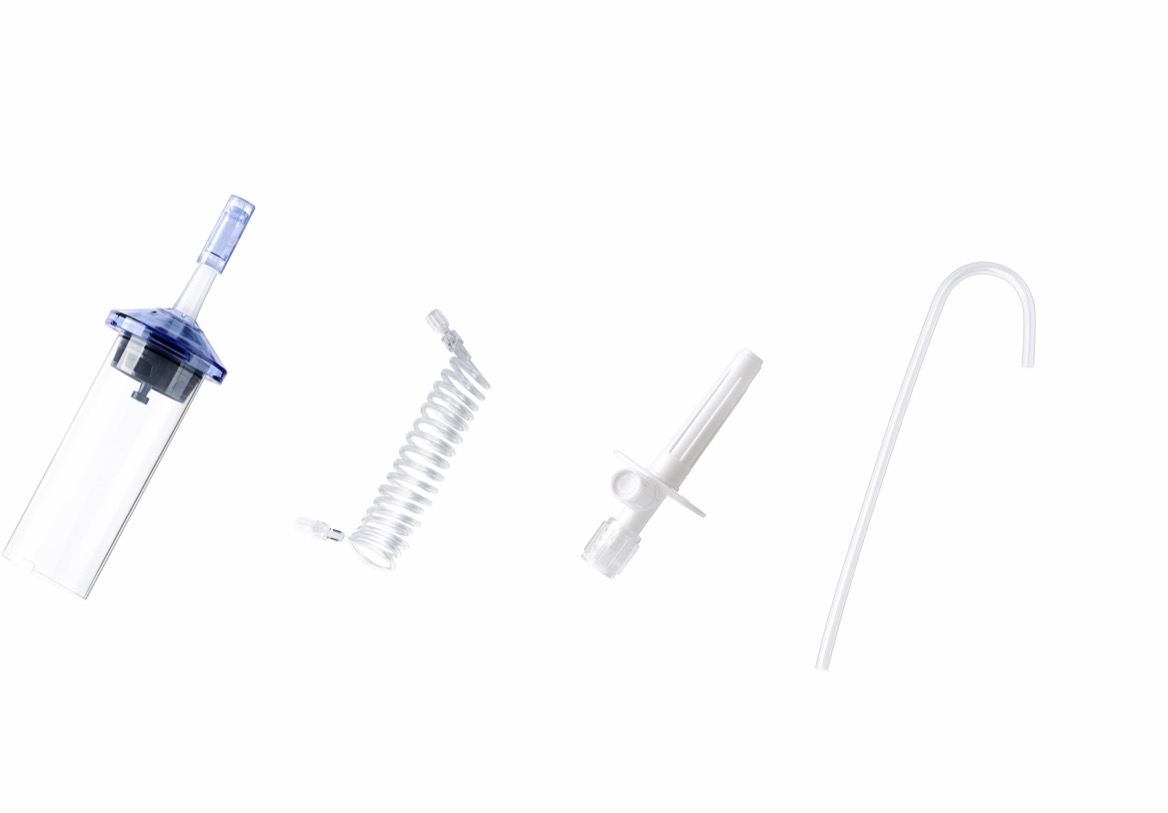
No. Suspected fluid bypass around the plunger requires evaluation. Filling residue can look similar, but a confirmed leaking syringe should not remain in use.
Do not assume a small visible leak is harmless. It creates uncertainty about device integrity, sterility, and delivered volume. Stop and follow the applicable replacement and assessment procedure.
No. Pressure is one part of the investigation. Seal condition, compatibility, loading, and pathway resistance also matter. A pressure alarm alone does not identify the failed component.
No. Do not modify a sterile disposable or attempt to restore a failed seal. Replace the affected product and investigate the cause through the appropriate technical process.
Not necessarily. A plunger leak occurs at the equipment; extravasation occurs at the vascular injection site. Assess the patient separately because either problem requires attention.
Not automatically. The delivered amount may be uncertain. The responsible clinician must consider the examination, available images, patient factors, and additional contrast exposure before deciding what to do next.
1. American College of Radiology. "Manual on Contrast Media." Relevant sections include Injection of Contrast Media, Extravasation of Contrast Media, and Contrast Media Warming. Supports the clinical distinctions, patient assessment, preparation, and temperature-management discussion. [acr]
2. Bayer Radiology Australia. "MEDRAD® Stellant Injection System." Relevant sections include compatibility, manufacturing quality considerations, and dedicated disposable configurations. Supports the discussion of model-specific compatibility and fluid-delivery performance. [radiology.bayer.com]
3. Saudi Ministry of Health. "Protocols on the Safe Use of Contrast Media in Radiology Departments." Supports the discussion of contrast warming, gadolinium handling, catheter selection, and power-injection considerations. [moh.gov]
4. U.S. Food and Drug Administration. "UPDATE: Evaluating Plastic Syringes Made in China for Potential Device Failures: FDA Safety Communication." Supports the discussion of leakage, dimensional changes, delivery reliability, traceability, and reporting. This is a broader syringe safety communication, not evidence of a defect in MAIWEI products. [fda]