


close
Choose Your Site
Global
Social Media
Views: 258 Author: Maiwei Biotech Publish Time: 2026-10-15 Origin: Site


Content Menu
● What Does "Top of the Injector Syringe" Actually Mean?
● Syringe-Tip Leakage vs. Connector Leakage: The Key Comparison
● Why Is Contrast Leaking From the Injector Syringe?
>> 1. The Connection Is Not Properly Engaged
>> 2. The Syringe Tip or Connector Is Damaged
>> 3. The Components Are Not Validated for That Injector
>> 4. Increased Resistance Exposes a Weak Connection
>> 5. Residual Contrast Looks Like an Active Leak
● Why Leakage Appears Only During High-Pressure Injection
>> Flow Rate and Contrast Viscosity
>> Pressure Ratings Are Component-Specific
● External Equipment Leakage vs. Contrast Extravasation
● A Practical Response to a Leaking Injector Syringe
● Expert Insight: Use Leak Timing to Narrow the Investigation
● A Better Incident Record: Capture the Assembly, Not Just the Syringe
● Preventing Recurrence Through Procurement and Training
>> Build a Model-Specific Compatibility Matrix
>> Review Patterns Across Reported Events
● How MAIWEI INC. Can Support Consumable Evaluation
>> Can I Fix a Leaking Syringe by Tightening the Connector?
>> Is Contrast Around the Syringe Tip Always a Leak?
>> Does a Standard Connector Prove Injector Compatibility?
>> Can High Pressure Cause Leakage?
>> Is Syringe Leakage the Same as Extravasation?
>> Should the Full Contrast Dose Be Repeated?
Contrast leaking from the top of the injector syringe can indicate an insecure connection, damaged syringe tip, incompatible connector, or another weakness exposed during pressurized injection. However, visible contrast around the syringe outlet may also be residue from filling or priming. The first task is to distinguish surface contamination from an active leak.
For radiographers, biomedical engineers, and purchasing teams, this is more than a housekeeping issue. A leaking contrast injector syringe can interrupt delivery, compromise the fluid pathway, and create uncertainty about the administered volume.
From a manufacturing-quality perspective, I would not begin by asking, "How much tighter should the connector be?" I would ask, "Where did the fluid first appear, when did it appear, and which components were connected?"
This guide compares syringe-tip leakage with connector leakage, explains relevant pressure factors, and provides a practical investigation framework. Device-specific instructions and institutional procedures always take priority.
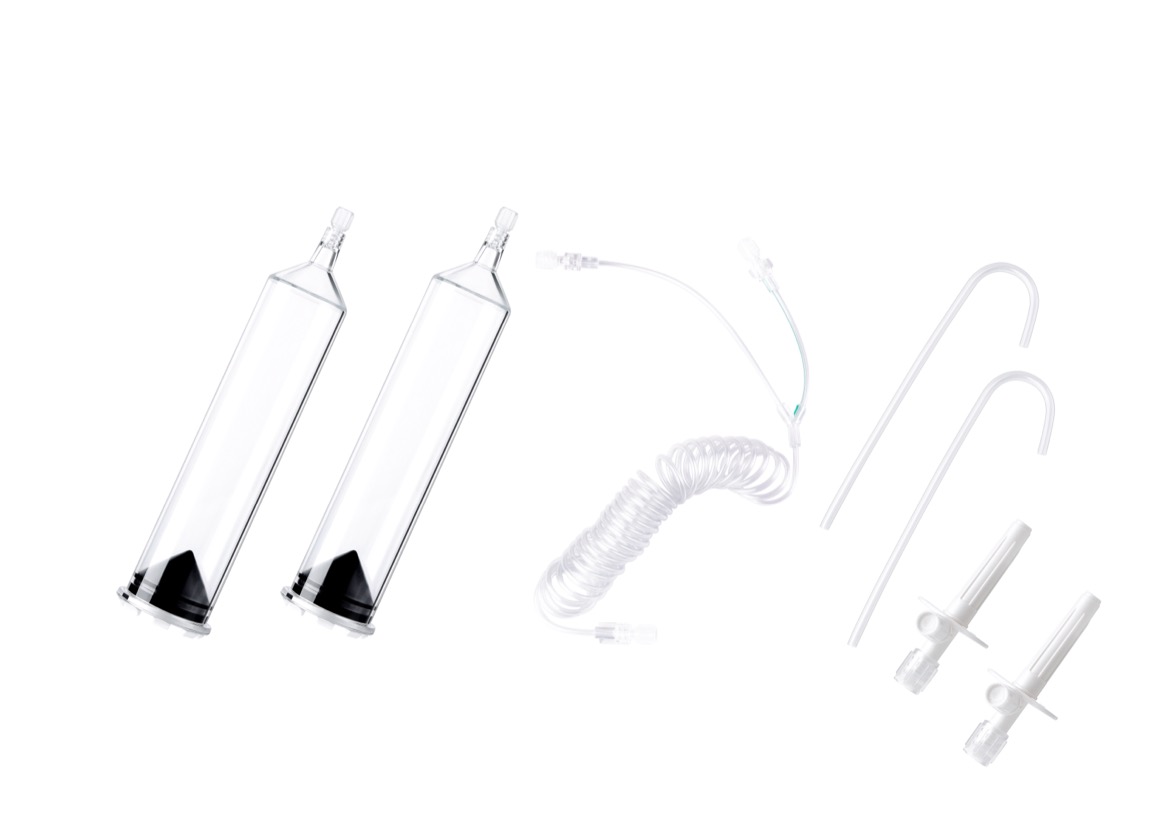
"Top" is an imprecise description because injector heads change orientation during preparation and use. Here, it means the outlet end where the syringe connects to a filling accessory or pressure-rated tubing.
Fluid in this area may originate from:
- The syringe outlet or tip.
- The syringe-to-tubing connection.
- A nearby tubing joint.
- A filling accessory.
- Contrast spilled during preparation.
Contrast can run along surfaces, making its final location different from its source. A wet syringe collar does not automatically prove that the collar itself failed.
The most useful observation is the first wet point, not the largest puddle.
These are related problems, but they require different investigations.
| Comparison point | Syringe-tip leakage | Connector leakage |
|---|---|---|
| Suspected origin | Outlet material or tip structure | Interface between mating components |
| Possible contributors | Cracking, deformation, handling damage | Incomplete engagement, damaged threads, unsuitable pairing |
| Useful observation | Fluid appears through or beside the tip material | Fluid appears around the joined interface |
| Main investigation focus | Syringe condition, handling history, lot | Both connectors, assembly method, compatibility |
| Appropriate response | Remove the affected disposable from clinical use | Stop use and assess the affected connected components |
These observations are investigative clues, not definitive diagnoses. A crack may be difficult to see, and a damaged connector can resemble a syringe defect.
Stop an active injection when leakage is detected. Do not attempt to tighten, disconnect, or repair a pressurized connection.
A connection may look assembled without being correctly engaged.
Possible contributors include incomplete engagement, misaligned threads, or tubing tension that places stress on the interface. Follow the specific connector's assembly instructions rather than applying a universal tightening technique.
Bayer's transfer-spike instructions explicitly warn that improper installation can cause damage or leakage and advise against overtightening.
The practical lesson is simple: secure assembly matters, but greater force does not necessarily produce a better seal.
Inspect unused components for visible cracks, deformation, damaged threads, and packaging abnormalities.
Damage can occur before use or during handling and assembly. Excessive tightening may also damage certain interfaces.
A component that leaks should not be returned to service merely because it appears intact after wiping. Small structural defects may be difficult to identify visually.
Replace affected disposables according to their instructions and local policy. Preserve identifying information when a quality investigation is needed.
Physical fit is not equivalent to validated compatibility.
A syringe or connector may appear to fit while lacking the correct intended application, pressure capability, or system-specific authorization.
Bracco's EmpowerCTA guidance, for example, specifies its approved syringes and connecting tubes and warns about incompatible supplies. Other systems have their own requirements.
Before combining components, verify:
- Exact injector model.
- Syringe and tubing product codes.
- Intended CT, MRI, or angiography application.
- Applicable pressure and flow limits.
- Manufacturer compatibility instructions.
- Relevant local regulatory status.
A generic connector description cannot replace model-specific documentation.
Pressure requirements depend on the complete fluid pathway.
A kink, closed flow-control component, unsuitable catheter, or other restriction may increase resistance. Contrast viscosity also influences resistance.
A marginal connection might remain dry during filling but leak when pressure increases. That timing is useful evidence, but it does not identify the root cause by itself.
Do not respond by raising pressure limits to force fluid through the pathway. Investigate the restriction and confirm all component limits first.
A droplet left after filling or priming can spread around the outlet.
This differs from fresh fluid appearing during preparation or injection. Nevertheless, residue should not be dismissed without checking the source and component condition.
Use only the cleaning method permitted by the relevant instructions. If fresh fluid reappears, treat it as a suspected leak rather than assuming the original droplet was harmless.
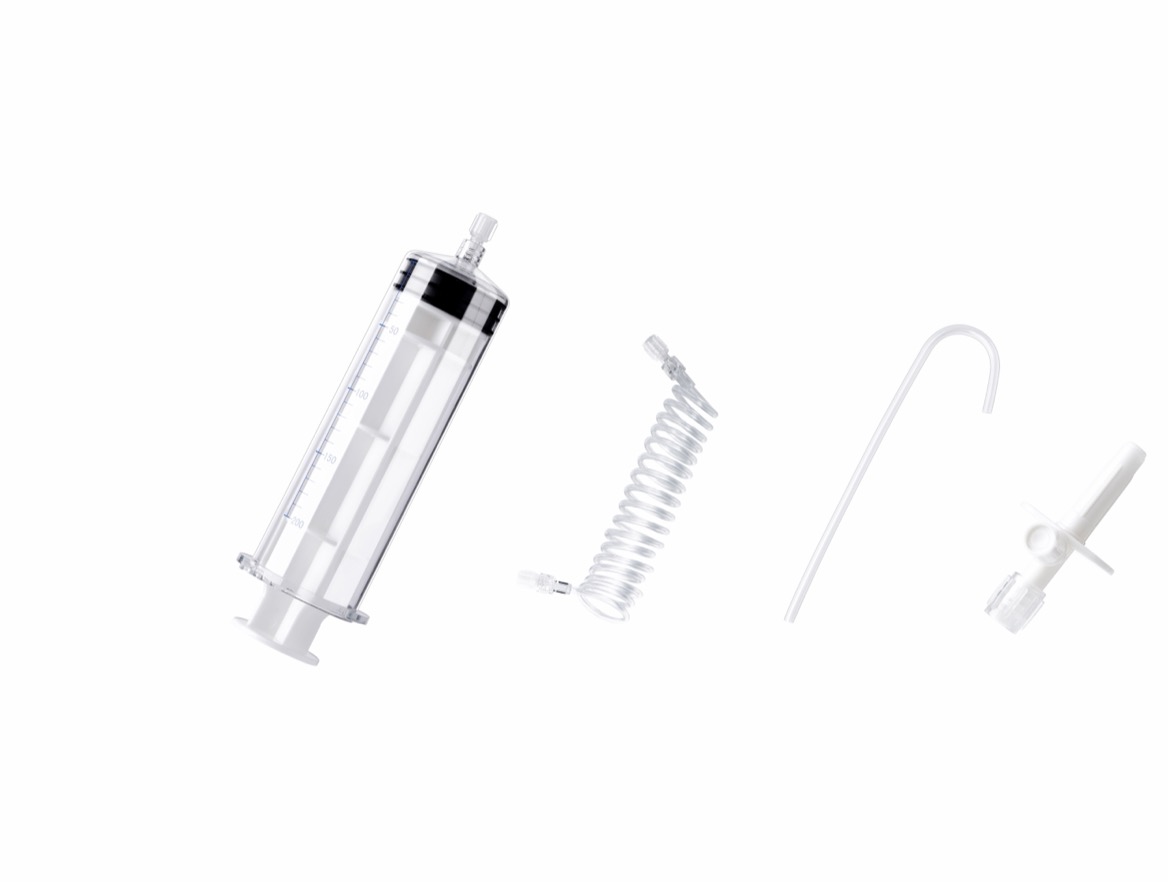
A connection can pass a visual inspection yet behave differently under pressure.
Delivering fluid through a resistant pathway requires pressure. The resistance depends on factors such as fluid viscosity, tubing geometry, and vascular access.
The American College of Radiology notes that warmed iodinated contrast is less viscous than room-temperature contrast and therefore encounters less resistance.
However, warming is not a remedy for a leaking connector. Follow the contrast agent's labeling and institutional warming procedures. Never improvise temperatures or use warming to compensate for damaged components.
Do not assume every syringe, connecting tube, extension, and catheter shares the injector's maximum pressure capability.
For example, the FDA documentation for the MEDRAD Stellant FLEX system identifies specific syringe kits and connector tubing for that system. Its specifications should not be generalized to unrelated products.
Check the limits of every component in the assembled pathway, including flow restrictions and intended use. The injector's capabilities do not override a disposable component's lower permitted limits.
These terms describe different events.
External equipment leakage means contrast escapes from the syringe, tubing, or a connection outside the patient.
Contrast extravasation means contrast escapes from the intended blood vessel into surrounding tissue.
| Feature | External equipment leakage | Contrast extravasation |
|---|---|---|
| Location | Syringe, connector, or tubing | Tissue near vascular access |
| Possible signs | Visible droplets or wet equipment | Swelling, tightness, burning, pain, or skin changes |
| Main concern | Fluid-path integrity and uncertain delivery | Patient tissue injury |
| Immediate priority | Stop injection and assess equipment | Stop injection and obtain clinical assessment |
Absence of pain does not exclude extravasation. Published guidance describes patients with little or no initial discomfort.
If leakage occurs during patient injection, assess both the equipment and the vascular access site. Do not assume that an external leak explains every symptom.
The following framework supports trained staff; it does not replace the injector's instructions.
1. Stop the injection.
Use the device's prescribed stopping procedure.
2. Assess the patient.
Check for symptoms and inspect the access site. Obtain appropriate clinical assessment when extravasation is suspected.
3. Make the system safe.
Follow the manufacturer's pressure-release and disconnection procedures. Never manipulate a pressurized joint.
4. Identify the first wet point.
Document the location before removing components when this can be done safely.
5. Replace affected disposables.
Do not patch, glue, tape, or otherwise repair a leaking fluid-path component.
6. Verify the complete assembly.
Confirm compatibility, permitted pressure and flow settings, component condition, and tubing routing.
7. Prepare the replacement pathway.
Follow device-specific filling and priming instructions. Remove air before patient connection.
8. Obtain authorization to resume.
Follow institutional procedures, particularly when delivered contrast volume is uncertain.
A completed injector display does not establish how much contrast reached the patient if fluid escaped externally. Additional dosing requires clinical judgment, not automatic repetition.
Timing provides a useful organizing framework.
| When fluid appears | What to investigate |
|---|---|
| During filling | Filling accessory, outlet connection, handling residue |
| During priming | Assembly integrity, visible damage, component pairing |
| Only during injection | Pressure-related loading, restrictions, stressed connections |
| After injection | Residual fluid, disconnection technique, system-specific behavior |
These are hypotheses, not verified causes.
Consider two illustrative situations:
- A droplet appears immediately after removing a filling accessory and does not recur. Residual contrast is a possibility.
- Fresh fluid appears around a connection only during injection. The interface, component pairing, and pressure conditions require investigation.
Neither scenario justifies continuing with a questionable disposable.
A complaint stating "the syringe leaked" provides limited investigative value.
A stronger record includes:
- Injector manufacturer and model.
- Syringe, tubing, and accessory product codes.
- Lot numbers and expiry dates.
- Contrast agent and concentration.
- Programmed flow rate and pressure limit.
- Actual pressure information, if available.
- Injection stage when leakage began.
- Leak location and photographs, where permitted.
- Vascular access details.
- Patient assessment and corrective actions.
Record observations separately from conclusions. "Fluid appeared around the connection" is an observation; "manufacturing defect" is a conclusion requiring evidence.
This distinction helps suppliers and hospitals investigate assembly issues, damaged components, recurrent device problems, and possible lot-related defects without prematurely assigning blame.
Prevention combines appropriate products with repeatable preparation.
List each injector model alongside permitted syringes, tubing, accessories, and operating limits.
Avoid purchasing based only on appearance, nominal syringe capacity, or broad statements such as "compatible with major brands."
Training should cover:
- Packaging and component inspection.
- Correct syringe loading.
- Connector engagement without excessive force.
- Tubing routing without avoidable tension or kinks.
- Air removal.
- Recognition of leakage and patient symptoms.
- Incident escalation.
Compare events by component pairing, injector, preparation step, operator training, and lot number.
Do not publish a leakage rate without reliable event definitions and an appropriate denominator. A collection of complaints cannot establish how frequently a product fails.
MAIWEI INC. describes its business as developing and manufacturing CT, MRI, and angiography injector syringes, connecting tubing, and related consumables, with exports to more than 60 countries and regions.
The company also reports ISO 13485, CE, and FDA 510(k) credentials. Buyers should request current documentation and confirm which products and markets each credential covers. FDA 510(k) clearance is product-specific, not blanket certification of every company product.
For hospitals, distributors, and OEM customers, the next step is a documented compatibility review.
Contact MAIWEI INC. with your injector model, intended application, required syringe capacity, tubing configuration, and operating requirements. Request applicable instructions, pressure specifications, regulatory documentation, and sample-evaluation support before routine clinical adoption.
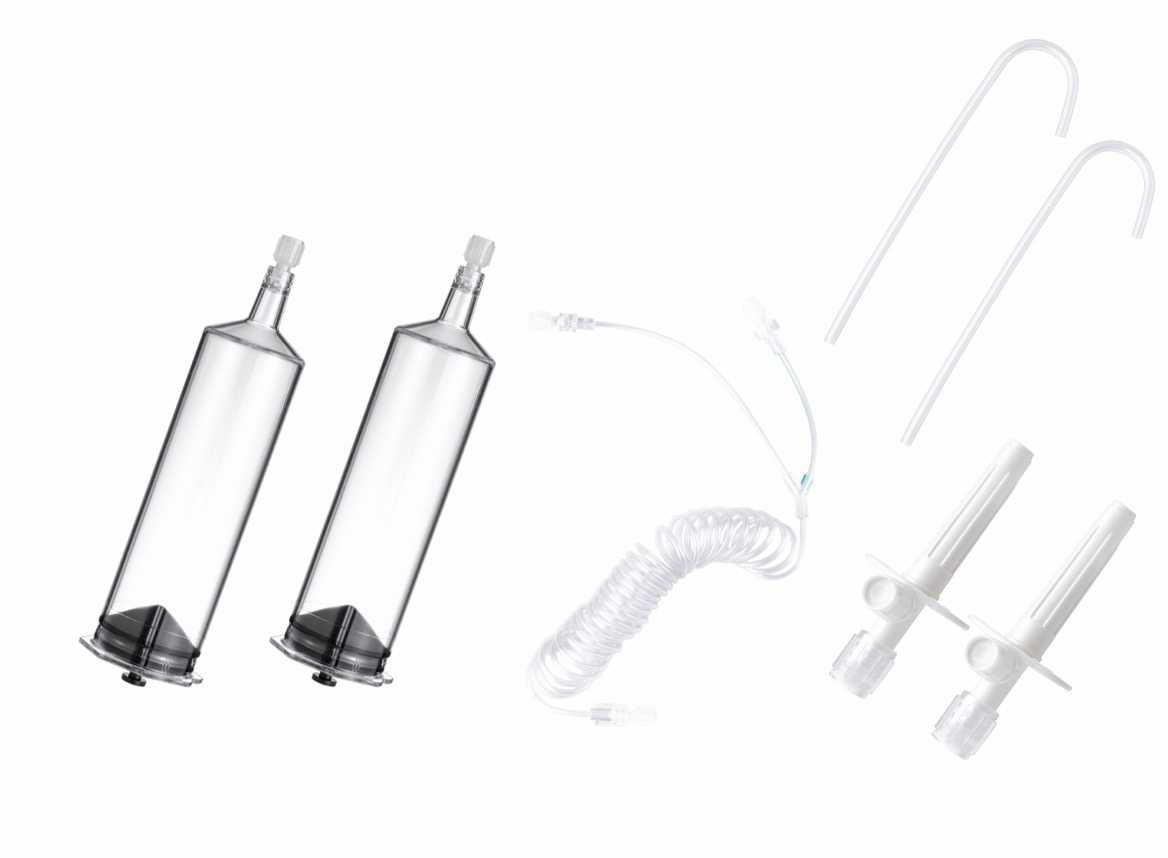
Do not tighten a connection during injection or while pressurized. Overtightening can damage certain components. Stop use and follow the relevant replacement and investigation procedures.
No. It may be residue from filling or priming. Fresh fluid that reappears requires investigation, especially during injection.
No. Compatibility requires product-specific documentation covering the injector, syringe, tubing, intended use, and operating limits.
Pressure can expose a damaged or inadequate interface. Investigate both the connection and downstream resistance rather than assuming pressure alone caused the problem.
No. Syringe leakage occurs outside the patient. Extravasation occurs in tissue outside the intended blood vessel. Both require prompt attention.
Not automatically. The delivered volume may be uncertain. The responsible clinical team must decide whether further contrast or imaging is appropriate.
1. Bayer. *MEDRAD Imaging Bulk Package Transfer Spike—Instructions for Use, Revision E*. Supports secure connections, avoidance of overtightening, and air removal before patient connection. [View instructions]. [radiologysolutions.bayer]
2. Bracco Injeneering. *EmpowerCTA / EmpowerCTA+ Injector System User's Guide*. Supports system-specific supply requirements and preparation instructions. [View user guide]. [appliedradiology]
3. U.S. Food and Drug Administration. *MEDRAD Stellant FLEX CT Injection System with Certegra Workstation: 510(k) Documentation, K182273*. Provides product-specific indications and syringe/tubing information. [View regulatory documentation]. [accessdata.fda]
4. American College of Radiology. *ACR Manual on Contrast Media, 2024*, hosted by Dartmouth. Supports viscosity, warming, injection safety, and extravasation assessment statements. [Read manual]. [geiselmed.dartmouth]
5. Roditi G, et al. *Intravenous Contrast Medium Extravasation: Systematic Review and Updated ESUR Contrast Media Safety Committee Guidelines*. European Radiology, 2022. Supports the extravasation distinction, symptoms, and clinical monitoring discussion. [Read article]. [pmc.ncbi.nlm.nih]
6. UCSF Radiology. *Intravenous CT & X-ray Contrast Guidelines*. Provides clinical information on extravasation and concerning symptoms. [Read clinical guidance]. [radiology.ucsf]